
Introduction
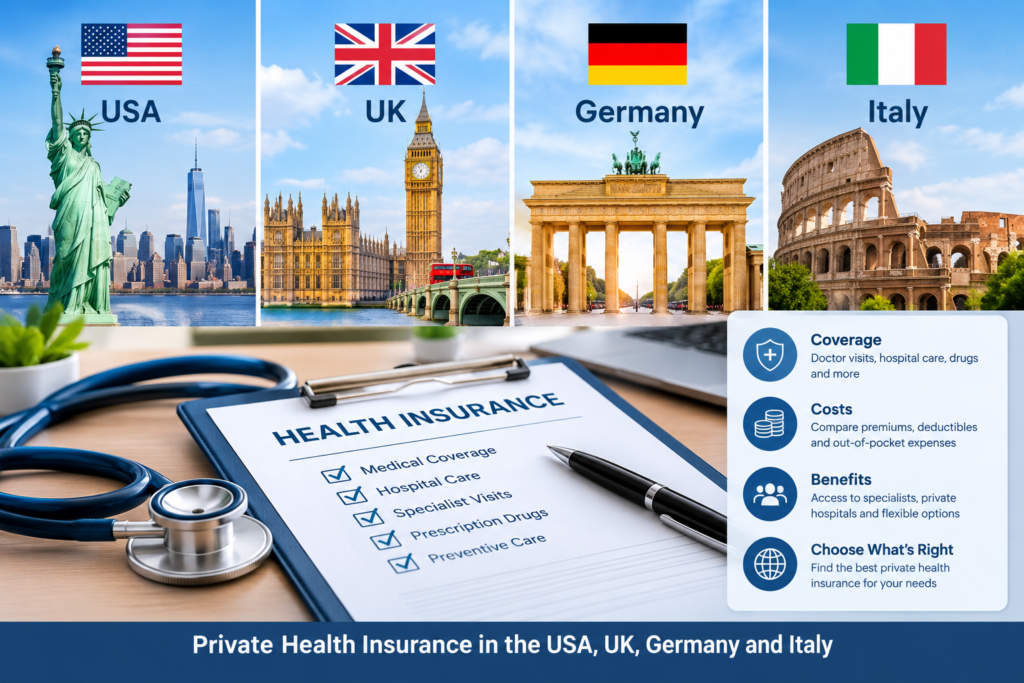
Private health insurance in the USA, UK, Germany and Italy plays an important role in helping people manage healthcare expenses, access medical specialists, and choose additional healthcare services. However, each country has a different healthcare system, which affects insurance costs, coverage options, and the benefits available to residents, workers, families, and international visitors.
In the United States, private health insurance is a major part of the healthcare system, and many people receive coverage through their employers or purchase individual plans. In the United Kingdom, the National Health Service (NHS) provides publicly funded healthcare, while private medical insurance offers an additional option for people seeking greater flexibility or faster access to certain treatments.
Germany combines statutory health insurance with private health insurance, giving eligible individuals different ways to obtain coverage. Italy, meanwhile, provides universal healthcare through its National Health Service, known as Servizio Sanitario Nazionale (SSN), while private insurance can help people access additional services.
Understanding private health insurance in the USA, UK, Germany and Italy is essential for anyone comparing healthcare systems, planning an international move, or researching medical coverage abroad. This guide explains how insurance works in each country, the main advantages and disadvantages, typical coverage considerations, and the factors to evaluate before choosing a policy.
What Is Private Health Insurance?
Private health insurance is a policy purchased from an insurance company to help pay for eligible medical expenses. Depending on the plan, it may cover doctor consultations, diagnostic tests, hospital treatment, prescription medicines, specialist appointments, and selected preventive services.
The exact benefits depend on the insurer, policy terms, local regulations, and the type of coverage purchased.
Private health insurance generally serves three purposes:
- Financial protection: It can reduce the amount policyholders pay directly for covered medical services.
- Access to healthcare: Some policies provide access to private hospitals, specialists, or additional treatment options.
- Greater flexibility: Depending on the plan, policyholders may have more choice over providers, appointment arrangements, or hospital accommodation.
However, private insurance does not automatically cover every medical expense. Deductibles, copayments, reimbursement limits, exclusions, waiting periods, and pre-existing condition rules can affect the value of a policy.
The role of private coverage also differs between countries. In some places, it provides the main route to comprehensive health insurance, while in others, it supplements a publicly funded healthcare system.
Private Health Insurance in the USA
The United States has a mixed healthcare system that includes employer-sponsored insurance, individual health plans, and public programs such as Medicare and Medicaid. Private health insurance is particularly important because healthcare costs can be substantial when people lack adequate coverage.
Unlike countries with universal public healthcare systems, the USA does not guarantee every resident comprehensive health coverage through a single national insurance program.
How Private Health Insurance Works in the USA
Many Americans receive health insurance through their employers. Employers often contribute toward monthly premiums, while employees pay the remaining amount through payroll deductions.
People who do not receive workplace coverage may purchase individual or family plans through the federal or state Health Insurance Marketplace, depending on where they live. Eligible individuals may qualify for financial assistance that reduces their insurance premiums or other healthcare costs.
Private plans generally have a defined network of doctors, hospitals, and other healthcare providers. The amount a patient pays depends on whether the provider is in the network and on the plan’s deductible, copayments, coinsurance, and annual out-of-pocket maximum.
Common plan types include:
- Health Maintenance Organization (HMO): Usually emphasizes an established provider network and may require referrals for specialist care.
- Preferred Provider Organization (PPO): Generally offers more flexibility in choosing providers, including some out-of-network services at a higher cost.
- Exclusive Provider Organization (EPO): Typically covers services only within its network, except for emergencies.
- High-Deductible Health Plan (HDHP): Has a higher deductible and may be paired with a Health Savings Account when eligibility requirements are met.
Each type has different rules, so comparing the details is essential before enrolling.
Coverage and Benefits in the USA
Private health insurance plans may cover a range of essential health services, including emergency care, hospitalization, prescription drugs, maternity care, mental health services, and preventive care. Coverage varies by plan and applicable law.
Under the Affordable Care Act, qualifying individual and small-group plans must cover specified essential health benefits. Other plan categories may follow different requirements.
Many plans also provide access to primary care physicians, specialist consultations, laboratory testing, imaging, and outpatient procedures.
Nevertheless, policyholders should check whether their preferred doctors and hospitals are included in the network. A plan with a low monthly premium may have a high deductible or limited provider choice.
Costs of Private Health Insurance in the USA
The cost of private health insurance in the USA depends on several factors, including age, location, household size, plan category, tobacco use where permitted in rating, and available subsidies.
Employer-sponsored coverage can be more affordable for employees because employers commonly pay part of the premium. Individual coverage may cost considerably more, particularly for people who do not qualify for financial assistance.
The total cost includes more than the monthly premium. Policyholders should also consider deductibles, copayments, coinsurance, prescription costs, and services that are not covered.
Before choosing a policy, compare the estimated yearly cost rather than focusing only on the monthly payment.
Advantages and Disadvantages of US Private Insurance
The main advantages include a wide range of plans, access to extensive specialist networks, and opportunities to select coverage according to individual needs.
However, premiums and out-of-pocket costs can be high. Insurance rules may also be complicated, and treatment outside the provider network can result in substantial expenses.
For many people in the USA, the best policy is not necessarily the cheapest one. It is the plan that balances premiums, medical needs, provider access, and financial protection.
Private Health Insurance in the UK
The United Kingdom has a publicly funded healthcare system delivered primarily through the National Health Service. Eligible residents can access many NHS services without paying the full cost at the point of treatment.
Private health insurance is optional for most people who already have access to NHS care. It is commonly used to obtain additional choice, access certain treatments more quickly, or receive care in private facilities.
How Private Health Insurance Works in the UK
Private medical insurance in the UK is available through individual policies and employer-sponsored benefits.
Individual customers purchase coverage directly from an insurer or through an insurance broker. Employers may also provide private medical insurance as part of a workplace benefits package.
Policies differ in their scope. Some focus on inpatient and day-patient treatment, while others include outpatient consultations, diagnostic tests, physiotherapy, and additional services.
Insurers may require customers to complete medical questionnaires or disclose their medical history. Depending on the policy, pre-existing conditions may be excluded, subject to underwriting rules and the specific terms offered.
Private medical insurance generally does not replace the NHS. People may continue using NHS services for routine care, emergencies, or treatments excluded from their private policies.
Benefits of Private Health Insurance in the UK
One important benefit is the possibility of faster access to selected consultations, investigations, or planned procedures, depending on the insurer’s network and local availability.
Some policies allow patients to choose from a list of private specialists and hospitals. Private accommodation may also be available when included in the policy.
Additional benefits can include diagnostic imaging, specialist consultations, and certain therapies. However, customers should check annual limits, referral requirements, and treatment exclusions.
Private insurance can be especially attractive to people who value flexibility and want an alternative route for eligible non-emergency treatment.
Costs of Private Health Insurance in the UK
The cost of private health insurance in the UK depends on age, location, medical history, coverage level, excess, and the insurer’s underwriting method.
A basic policy with limited outpatient benefits may cost less than comprehensive coverage that includes consultations, diagnostic testing, and a broader range of treatments.
Customers can sometimes lower premiums by selecting a higher excess, limiting outpatient coverage, or agreeing to use a defined hospital network. However, these choices may increase personal expenses when treatment is needed.
Employer-provided policies can also reduce the direct financial burden on employees, although tax treatment may apply to workplace benefits.
Advantages and Disadvantages of UK Private Insurance
Private health insurance offers additional choice and can help people access selected treatments outside the NHS pathway.
Its limitations include exclusions, premiums, excess payments, and the possibility that some conditions or treatments will not be covered. It also does not guarantee immediate appointments or eliminate all waiting times.
For many UK residents, NHS care remains the foundation of healthcare access, while private insurance provides optional additional benefits.
Private Health Insurance in Germany
Germany operates a system of universal health coverage based on statutory health insurance and private health insurance. Health insurance is compulsory for residents, but the rules governing which system an individual can use depend on their employment status, income, and other circumstances.
Germany differs from the UK and Italy because private health insurance can serve as a primary, substitutive form of coverage for eligible individuals rather than functioning only as supplementary insurance.
How Private Health Insurance Works in Germany
Most residents are covered through statutory health insurance, known as Gesetzliche Krankenversicherung (GKV). Statutory coverage is financed primarily through income-related contributions shared between employees and employers, subject to applicable rules.
Private health insurance, or Private Krankenversicherung (PKV), is available to eligible groups. These may include certain higher-earning employees, self-employed individuals, and civil servants, although eligibility conditions vary.
The income threshold for employees is updated periodically, so applicants should verify the current annual limit before making a decision.
Unlike statutory insurance, private premiums are generally calculated using factors such as the selected benefits, entry age, and health underwriting. Depending on the contract and legal requirements, insurers may apply risk-related pricing or exclusions.
Private insurance may reimburse treatment according to the policy’s agreed benefits, with customers sometimes paying the provider first and then claiming reimbursement.
Coverage and Benefits in Germany
Private health insurance in Germany can offer comprehensive medical coverage, including specialist consultations, hospital treatment, diagnostic tests, and prescription medicines, depending on the contract.
Some policies include enhanced hospital accommodation, treatment by senior physicians, or broader reimbursement arrangements. Dental benefits and other services vary considerably between plans.
However, not every private policy provides identical protection. Customers should carefully review reimbursement limits, deductibles, exclusions, and how premiums may change over time.
Germany’s statutory system also provides extensive healthcare benefits, so private insurance should not automatically be considered superior for every person.
Costs of Private Health Insurance in Germany
Private insurance costs in Germany depend on the applicant’s age at entry, health assessment, selected benefits, deductible, and contractual arrangements.
People who select comprehensive benefits may pay more than those who choose a plan with a higher deductible or narrower benefits. Premiums may also change over time under applicable rules.
One important consideration is long-term affordability. Someone moving from statutory to private insurance should assess not only today’s premium but also their future income, family circumstances, and retirement plans.
Family coverage also differs from statutory insurance. Eligible family members may receive no-contribution coverage under certain statutory conditions, whereas private insurance generally requires separate premiums for insured family members.
Advantages and Disadvantages of German Private Insurance
Potential advantages include enhanced benefits, access to certain private treatment arrangements, and reimbursement options determined by the contract.
Disadvantages may include medical underwriting, separate premiums for family members, and the need to plan carefully for long-term affordability.
Switching between statutory and private insurance is subject to legal conditions and may be difficult in some circumstances. Individuals should obtain independent advice before making a major change.
For international workers, students, and self-employed people, understanding the eligibility rules is particularly important because choosing the wrong policy can create problems with residence or employment requirements.
Private Health Insurance in Italy
Italy provides universal healthcare through the Servizio Sanitario Nazionale (SSN). The system is publicly financed and administered through regional health services, which means access arrangements and waiting times can vary between locations.
Private health insurance is optional for many residents and is generally used to supplement public coverage rather than replace the entire national healthcare system.
How Private Health Insurance Works in Italy
People can purchase private medical insurance from domestic or international insurers. Employers may also offer health benefits through workplace schemes or supplementary healthcare funds.
Policies may reimburse eligible medical expenses or provide access to participating private hospitals, clinics, diagnostic centres, and specialists.
Some plans focus on hospitalization and major medical expenses, while others include specialist consultations, diagnostic tests, dental services, and preventive care.
Because Italy’s public healthcare system already provides broad coverage to eligible residents, customers should identify the specific services they want to supplement before buying a policy.
Benefits of Private Health Insurance in Italy
Private coverage can provide additional options for specialist consultations, diagnostic appointments, and treatment in private facilities.
For some people, the main attraction is the ability to arrange eligible appointments through a private provider rather than relying exclusively on public-sector availability.
Depending on the policy, benefits may include inpatient treatment, surgery, specialist visits, laboratory tests, medical imaging, and selected rehabilitation services.
However, the benefits available depend on the plan, provider network, reimbursement rules, and exclusions. Private coverage does not guarantee that every medical expense will be paid.
Costs of Private Health Insurance in Italy
The price of private health insurance in Italy depends on age, location, medical history, coverage level, deductible, and the number of people insured.
A policy that covers major hospitalization may cost less than a comprehensive plan including outpatient consultations, dental care, and broad reimbursement benefits.
Family policies may offer bundled pricing, but the terms vary by insurer.
Before purchasing coverage, customers should compare annual limits, waiting periods, pre-existing condition exclusions, and whether treatment must be received through an approved provider.
Residents should also consider which services they can already access through the SSN, so they do not pay for benefits that provide limited additional value.
Advantages and Disadvantages of Italian Private Insurance
Private health insurance can offer more choice over certain appointments, access to private facilities, and additional services not fully covered by a particular public arrangement.
On the other hand, premiums, exclusions, and reimbursement limits can create extra expenses. Public healthcare availability also varies by region, so the value of private insurance may differ between cities and local areas.
For many residents, combining public healthcare with carefully selected private coverage provides a practical balance between affordability and flexibility.
Comparison of Private Health Insurance in Four Countries
Private health insurance in the USA, UK, Germany and Italy differs in its role, eligibility rules, and relationship with public healthcare.
The following table summarizes the main distinctions.
| Feature | USA | UK | Germany | Italy |
|---|---|---|---|---|
| Main healthcare model | Mixed public and private | Tax-funded NHS | Statutory and private insurance | Public SSN |
| Is health coverage compulsory? | Requirements depend on circumstances and jurisdiction | NHS eligibility rules apply | Health insurance is compulsory for residents | SSN eligibility depends on residence and applicable rules |
| Role of private insurance | Major source of coverage | Optional supplement | Can be primary or supplementary | Mainly supplementary |
| Employer insurance | Common | Available as a workplace benefit | Common statutory contributions; private options for eligible groups | Available through employers and benefit schemes |
| Premium calculation | Varies by plan and applicable rules | Depends on policy and underwriting | Depends on statutory or private arrangements | Depends on policy and underwriting |
| Public healthcare | Available through eligible programs and services | NHS | Statutory insurance and public providers | SSN |
| Main reason to buy private cover | Medical cost protection and provider access | Additional choice and access | Contract-specific benefits or eligible private coverage | Additional choice and private treatment |
This comparison illustrates why a policy that works well in one country may not be appropriate in another. Insurance regulations, eligibility rules, tax treatment, and access to public services all influence the best choice.
Which Country Has the Most Affordable Private Health Insurance?
There is no single answer because insurance premiums depend on the person, the type of policy, and the benefits being compared.
The USA can be expensive, particularly for people who must purchase comprehensive coverage without employer assistance or subsidies. However, actual costs vary widely between plans and households.
In the UK, the NHS provides a public alternative for eligible residents, so private insurance is often purchased for additional convenience or access rather than as the only route to healthcare.
Germany has a broad statutory system and a private insurance market for eligible individuals. Whether private insurance is affordable depends on the contract, personal circumstances, and long-term financial planning.
In Italy, eligible residents can use the SSN for public healthcare, while private insurance can provide additional services. A more limited supplementary policy may be sufficient for someone who mainly wants private specialist appointments.
The most useful comparison considers annual premiums, deductibles, copayments, exclusions, covered services, and likely medical needs.
Private Health Insurance for Expats and International Residents
People moving between countries should not assume that a domestic health insurance policy will automatically cover them abroad.
Eligibility for public healthcare depends on residence status, employment, registration, and national rules. International private medical insurance may be useful for temporary stays, but it may not satisfy every country’s requirements for residence, employment, or long-term coverage.
What Expats Should Check Before Buying Insurance
First, confirm whether you must register with a public or statutory health insurance system. Germany, in particular, has compulsory health insurance requirements and specific rules governing eligibility for statutory and private coverage.
Second, verify whether your visa or residence permit requires a particular type of medical insurance. A travel policy may not provide the comprehensive benefits required for long-term residence.
Third, review international coverage carefully. Some policies exclude treatment in the country where you permanently reside or limit coverage to emergencies.
Fourth, check how the policy handles pre-existing conditions, prescription medicines, maternity care, routine appointments, and medical evacuation.
Finally, determine whether your insurer pays healthcare providers directly or requires you to pay first and claim reimbursement later.
International residents should also check whether their employer provides coverage and whether dependants need separate policies.
How to Choose the Right Private Health Insurance Policy
Choosing health insurance requires more than comparing monthly premiums. A suitable policy should provide meaningful protection while remaining affordable over time.
1. Assess Your Healthcare Needs
Consider your age, medical history, family circumstances, preferred doctors, and expected use of healthcare services.
Someone who rarely needs treatment may prefer a different level of coverage from someone who requires regular specialist appointments or ongoing prescriptions.
2. Compare the Total Cost
Review the premium alongside deductibles, copayments, coinsurance, reimbursement limits, and uncovered services.
A low premium may not be the best value if you would face substantial expenses when making a claim.
3. Check Hospital and Doctor Networks
Confirm whether your preferred hospitals, clinics, and specialists accept the policy.
In the USA, network restrictions can significantly affect costs. In the UK and Italy, access to particular private providers may depend on insurer agreements. In Germany, reimbursement depends on the policy terms and applicable rules.
4. Review Exclusions and Waiting Periods
Read the policy wording to understand which treatments are covered, which are excluded, and whether waiting periods apply.
Pay particular attention to pre-existing conditions, maternity care, dental treatment, mental health services, and long-term conditions.
5. Consider Family Coverage
Families should compare the cost and benefits of insuring each member. Germany’s statutory and private systems treat family coverage differently, while employer-sponsored plans in the USA and other countries may offer family options.
6. Think About Long-Term Affordability
Insurance is an ongoing financial commitment. Consider whether the premiums are likely to remain manageable if your income changes, your family grows, or you retire.
This is particularly important when choosing private health insurance as a substitute for statutory coverage in Germany.
7. Verify Legal and Residency Requirements
Before moving abroad, confirm the insurance rules that apply to your employment and residence status. Contact the relevant national authority or a qualified insurance adviser if the requirements are unclear.
Common Mistakes to Avoid When Buying Private Health Insurance
People often choose insurance based only on its advertised price. This can result in unexpected expenses when they discover that their preferred treatment or provider is not covered.
Other common mistakes include overlooking exclusions, assuming that all private hospitals are included, and failing to check whether pre-existing conditions affect eligibility.
International residents sometimes purchase short-term travel insurance when they actually need long-term health coverage. These products serve different purposes and may have different benefits and restrictions.
Another mistake is assuming that private insurance eliminates waiting times. Private providers can also have limited appointment availability, and insurers may require authorization before treatment.
Finally, policyholders should review renewal conditions and changes in premiums. A policy that appears affordable today may become less suitable as circumstances change.
Frequently Asked Questions (FAQs)
1. What is private health insurance in the USA, UK, Germany and Italy?
Private health insurance in the USA, UK, Germany and Italy refers to medical coverage purchased from an insurance company. Its role varies by country: it is a major source of coverage in the USA, an optional supplement in the UK and Italy, and either primary or supplementary coverage for eligible people in Germany.
2. Which country relies most heavily on private health insurance?
The USA relies more heavily on private health insurance as a source of medical coverage than the UK or Italy. Germany also has a substantial private insurance sector, but most residents are covered through statutory health insurance.
3. Is private health insurance compulsory in Germany?
Health insurance is compulsory for residents in Germany. Eligible people may be covered through statutory health insurance or qualifying private insurance, depending on their circumstances and the applicable rules.
4. Is private health insurance necessary in the UK?
Private health insurance is not necessary for most eligible residents to access NHS healthcare. Some people choose it for additional provider choice, private facilities, or potentially faster access to selected planned treatments.
5. Can residents in Italy use public healthcare without private insurance?
Eligible residents can generally access services through Italy’s National Health Service without purchasing private health insurance. Private policies are optional for many people and may provide additional services or access to private providers.
6. Does private health insurance cover pre-existing conditions?
Coverage depends on the insurer, the policy, and local regulations. Some policies exclude pre-existing conditions, while others may offer limited or specially underwritten coverage. Applicants should disclose relevant medical information accurately and review the policy wording.
7. Can international students buy private health insurance?
International students may be able to purchase private health insurance, but the appropriate option depends on their destination, student status, age, and local rules. Students should confirm whether public or statutory coverage is available and whether their chosen policy meets visa and enrolment requirements.
8. Is international health insurance the same as travel insurance?
No. Travel insurance usually focuses on unexpected medical emergencies and other travel-related risks during temporary trips. International health insurance may provide broader medical coverage for people living abroad, subject to the contract and eligibility conditions.
9. What should I compare before choosing a policy?
Compare premiums, deductibles, copayments, annual limits, provider networks, exclusions, waiting periods, prescription coverage, and claims procedures. Also consider your eligibility for public healthcare and the amount of financial protection you need.
10. Can private health insurance provide access to private hospitals?
Yes, if the policy includes the hospital and treatment concerned. However, customers should confirm the insurer’s network, reimbursement limits, and any authorization requirements before arranging non-emergency treatment.
Internal Linking Suggestions
To strengthen your website’s SEO structure, link this article to relevant existing pages using descriptive anchor text. Only use URLs that actually exist on your website.
Suggested internal links include:
- Health Insurance in Europe: Link to your country-by-country overview of European healthcare.
- Health Insurance for Expats: Link to a guide explaining international medical coverage and residency requirements.
- International Health Insurance Plans: Link to a comparison of policies for people living abroad.
- Healthcare Costs in Europe: Link to an article about medical expenses and public healthcare funding.
- Travel Insurance vs. Health Insurance: Link to a guide explaining the differences between these insurance products.
Place links naturally within the relevant paragraphs. Avoid linking every keyword to the same page.
External Authority Link Suggestions
For accurate information and stronger reader trust, link to relevant government and established healthcare resources.
- USA — HealthCare.gov: https://www.healthcare.gov/
Use this resource for information about Marketplace coverage, plan categories, enrollment, and potential financial assistance. - UK — NHS: https://www.nhs.uk/
Use the NHS website to explain publicly funded healthcare services and patient information. - Germany — Federal Ministry of Health: https://www.bundesgesundheitsministerium.de/en.html
Use this resource for information about Germany’s health insurance system and applicable healthcare policies. - Italy — Ministry of Health: https://www.salute.gov.it/
Use this resource for official information about Italy’s National Health Service and public healthcare arrangements. - International comparison — OECD: https://www.oecd.org/en/topics/health.html
Use OECD health publications for comparative information on healthcare financing, access, expenditure, and insurance systems.
Verify that each destination is relevant to the paragraph where it appears, and use descriptive anchor text rather than generic phrases such as “click here.”
Conclusion
Private health insurance in the USA, UK, Germany and Italy serves different purposes because each country organizes healthcare in a different way. Understanding these differences can help individuals, families, workers, and international residents make better-informed decisions about medical coverage.
The USA depends heavily on a combination of private insurance and public programs. The UK offers NHS healthcare to eligible residents, with private insurance providing additional options. Germany combines statutory health insurance with private insurance for eligible groups, making eligibility and long-term affordability important considerations. Italy provides universal public healthcare through the SSN, while private insurance can supplement available services.
There is no single policy that is best for everyone. The right choice depends on personal circumstances, healthcare needs, budget, residency status, and the benefits offered by each insurer.
Before purchasing a policy, compare its total cost, provider network, coverage limits, exclusions, and claims process. International residents should also verify local insurance requirements before moving.
By carefully evaluating these factors, readers can better understand private health insurance in the USA, UK, Germany and Italy and select coverage that aligns with their medical needs and financial priorities.
USA — Health Insurance: https://www.healthcare.gov/
UK — NHS Healthcare: https://www.nhs.uk/
Germany — Federal Ministry of Health: https://www.bundesgesundheitsministerium.de/en.html
Italy — Ministry of Health: https://www.salute.gov.it/
International Healthcare Data — OECD: https://www.oecd.org/en/topics/health.html

1 comment