Property ownership is widely regarded as one of the most reliable wealth-building strategies in the modern world. Whether you own a cozy single-family home in Texas, an apartment complex in London, a historic villa in Bavaria, or a commercial office space in New York, real estate represents a massive financial commitment. However, holding valuable real estate also exposes owners to unpredictable risks. Natural disasters, severe weather events, accidental structural fires, plumbing failures, vandalism, and third-party liability claims can instantly compromise your investments.
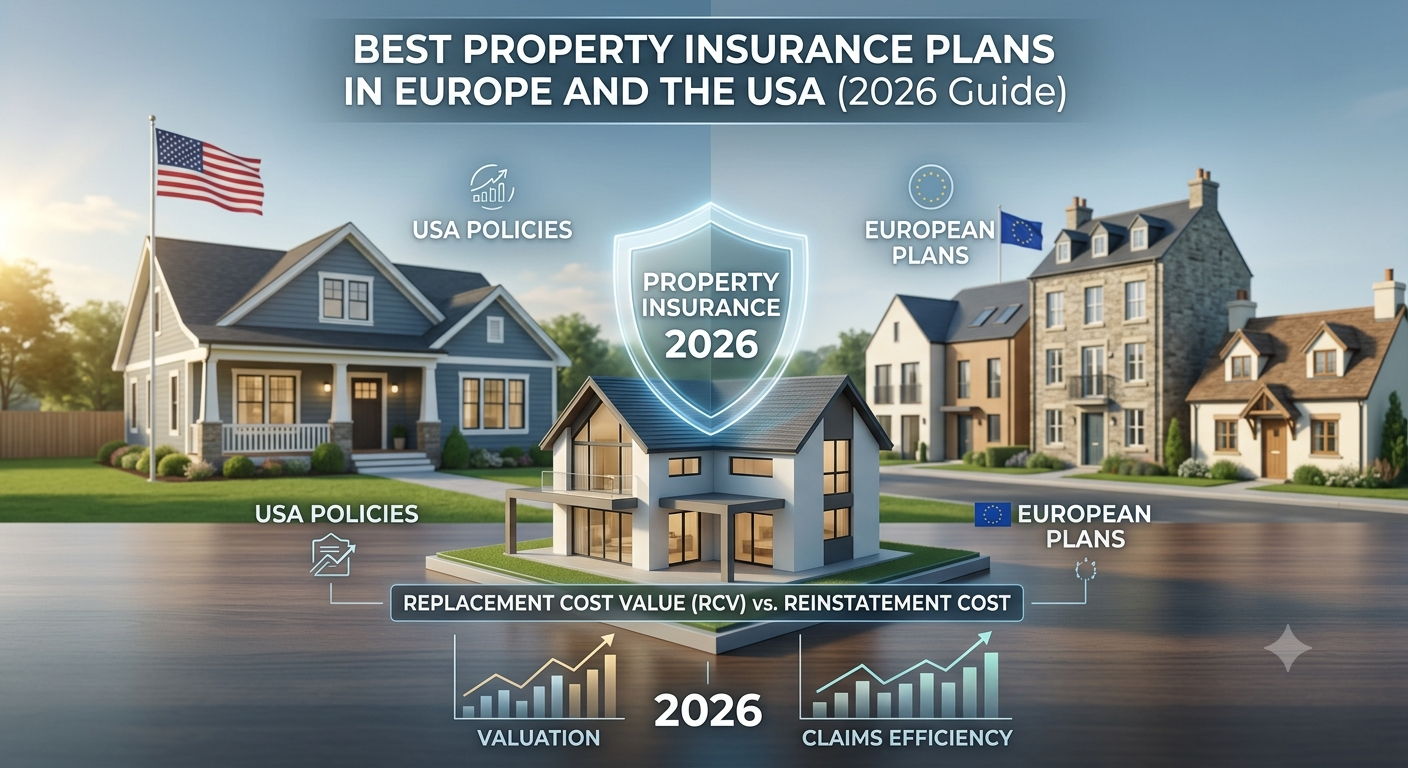
Navigating the real estate market requires an in-depth understanding of how to safeguard your assets against unexpected loss. Finding the Best Property Insurance Plans in Europe and the USA (2026 Guide) requires navigating two vastly different legal, financial, and regulatory markets. While American property insurance heavily relies on bundled open-peril policies, European insurance leans toward modular, split-coverage agreements designed around localized risks.
This comprehensive guide breaks down everything you need to know about real estate protection. We will explore the primary market differences between North America and Europe, highlight the best insurance companies in each region, analyze crucial coverage categories, and provide proven strategies to reduce your annual premiums.
Understanding Property Insurance in 2026: USA vs. Europe
To choose the right policy for your real estate assets, you must first understand how insurance systems operate in the United States compared to the United Kingdom and continental Europe. While the fundamental goal remains the same—protecting the owner against catastrophic financial loss—the underlying mechanics, regulatory standards, and policy structures differ significantly.
+---------------------+-----------------------------------+-----------------------------------+
| Feature             | United States Market              | European / UK Market              |
+---------------------+-----------------------------------+-----------------------------------+
| Policy Structure    | Combined Homeowners (HO-3/HO-5)   | Split: Buildings vs. Contents     |
| Primary Valuation   | Replacement Cost Value (RCV)      | Reinstatement / Sum Insured       |
| Climate Deductibles | Mandatory Hurricane/Hail (1–5%)   | Standard Flat Excess Fees         |
| Tech Integration    | High (Smart sensors, AI quotes)   | High (Fully digital app policies) |
+---------------------+-----------------------------------+-----------------------------------+
The American Property Insurance Model
In the United States, property insurance is largely standardized through policy forms established by insurance rating bureaus. The vast majority of single-family homeowners purchase bundled policies known as HO-3 (Special Form) or HO-5 (Comprehensive Form).
An HO-3 policy typically provides open-peril protection for the physical structure of the building. This means that any damage caused to the structure is covered unless the specific cause of damage is explicitly excluded in the contract. Common exclusions in standard US policies include floods, earthquakes, mudslides, war, and wear-and-tear due to poor maintenance. Personal property inside the structure under an HO-3 policy is usually protected on a named-peril basis, meaning damage is covered only if caused by risks specifically listed in the contract (such as fire, theft, or explosion).
For higher-end homes, the HO-5 policy offers open-peril protection for both the physical structure and personal belongings, offering broader financial protection and fewer restrictive limits on high-value items.
The European and UK Property Insurance Model
In contrast, the European market—including the United Kingdom, Germany, France, and Spain—operates largely on a split-coverage framework. Rather than purchasing one all-inclusive policy, real estate owners typically evaluate two distinct insurance products:
- Buildings Insurance (Gebäudeversicherung in Germany): This covers the physical shell of the structure, including permanent fixtures, walls, roofs, fitted kitchens, and underground piping.
- Contents Insurance (Hausratversicherung in Germany): This covers portable personal possessions inside the home, such as furniture, consumer electronics, clothing, and personal valuables.
In countries like the UK, policyholders can purchase these two plans together as a combined policy from a single provider, but they remain fundamentally distinct contracts with individual limits, terms, and deductibles (known locally as “excess”).
Furthermore, European protection heavily focuses on the exact rebuild value—known as the Reinstatement Cost or Sum Insured—rather than the market value of the property. Insurance companies in Europe require owners to calculate exact structural rebuild costs based on square meters and regional construction labor rates.
Top Property Insurance Providers in the USA (2026)
Selecting an insurance provider in the United States involves balancing financial stability, claims processing efficiency, customer service reputation, and overall pricing competitiveness. Insurers in the US are rated by independent credit rating agencies such as AM Best, and consumer satisfaction is regularly benchmarked by research organizations like J.D. Power. Exploring the Best Property Insurance Plans in Europe and the USA (2026 Guide) highlights several top-performing US carriers this year.
1. Amica Mutual – Best Overall Customer Experience
Amica Mutual consistently ranks at the top of customer satisfaction surveys across the American market. Unlike publicly traded stock insurance companies, Amica operates as a mutual company, meaning it is owned by its policyholders.
- Core Strengths: Amica excels in customer service transparency, rapid claims settlement, and high retention rates. Their flagship homeowners policies include built-in catastrophic protections and generous coverage extensions for structural repairs.
- Key Feature: The Contractors Network Program, which connects homeowners directly with pre-screened, licensed, and insured repair professionals after a covered loss occurs.
- Best Suited For: Owners who prioritize stress-free claims handling, dedicated customer service representatives, and potential annual dividend payouts on paid premiums.
2. State Farm – Best for Policy Bundling and Regional Support
As the largest property and casualty insurance carrier in North America, State Farm holds an expansive network of local captive agents spread across nearly every ZIP code in the US.
- Core Strengths: State Farm offers exceptional multi-policy discounts when home coverage is combined with auto, umbrella, or commercial liability policies. Their financial strength is unmatched, giving policyholders peace of mind during widespread natural disasters.
- Key Feature: Extensive local agent networks that provide personalized, in-person advice tailored to specific municipal hazards and regional weather threats.
- Best Suited For: Multi-property owners, families, and real estate investors looking to consolidate their insurance portfolio under a reliable, single-source insurer.
3. Chubb & AIG – Premier High-Value & Luxury Real Estate Coverage
Standard home insurance policies often feature coverage sub-limits that fall short when protecting luxury estates, historic residences, or high-value architectural marvels. Chubb and AIG Private Client Group dominate this specialized market segment.
- Core Strengths: Custom underwriting solutions designed specifically for properties valued at $750,000 to over $10,000,000. These policies eliminate standard restrictive sub-limits on luxury interior finishes, custom woodwork, and imported building materials.
- Key Feature: Guaranteed Replacement Cost coverage. If a severe disaster destroys your home, Chubb or AIG will pay to rebuild the structure back to its original luxury state—even if the total cost exceeds the policy face-value limit.
- Best Suited For: Owners of high-net-worth real estate, historic structures, luxury vacation homes, and properties containing high-value art or antique collections.
Top Property Insurance Providers in Europe and the UK
European property owners require insurance carriers that can navigate complex multi-jurisdictional laws, varied building regulations, and multi-currency transactions. Below are the top-performing insurance providers across Europe and the UK for 2026.
1. Allianz – Best Pan-European & Cross-Border Coverage
Headquartered in Munich, Germany, Allianz is one of the world’s largest financial services and insurance organizations. It provides comprehensive real estate protection across all major European economies.
- Core Strengths: Unmatched cross-border operational capabilities. Allianz allows property owners with real estate portfolios spread across multiple European nations (such as Germany, France, Italy, and Spain) to manage coverage under unified corporate structures.
- Key Feature: Flexible, modular building insurance plans that allow property owners to tailor environmental risk riders, sustainability rebuild options, and liability limits.
- Best Suited For: European real estate investors, cross-border homeowners, and individuals holding multiple residential or commercial assets in the European Union.
2. AXA & LV= – Best Comprehensive UK Coverage
In the United Kingdom, AXA Insurance and LV= (Liverpool Victoria) remain industry benchmarks for residential building and contents protection.
- Core Strengths: Highly competitive pricing models, broad coverage protections for older UK home structures, and consistent 5-star ratings from independent financial research organization Defaqto.
- Key Feature: Advanced accidental damage add-ons that cover household incidents, alongside standard 24/7 home emergency assistance lines for plumbing, roofing, and heating failures.
- Best Suited For: UK homeowners, landlords, and buyers seeking reliable, high-rated protection with customizable excess structures.
3. Feather & Lemonade – Best Digital Insurtechs (Germany & Expats)
For international residents, digital nomads, and tech-savvy property owners living or investing in Germany and continental Europe, traditional insurance bureaucracies can present significant language and administrative hurdles. Modern insurtech platforms like Feather and Lemonade have disrupted this market.
- Core Strengths: Fully digitized onboarding, instant online policy issuance, clear transparent pricing, and 100% English-language customer support and policy documentation.
- Key Feature: Seamless mobile app management that allows policyholders to file claims in seconds by uploading photos, videos, and receipts directly from their smartphones.
- Best Suited For: Expatriates, international property investors in Germany, renters, and tech-focused homeowners who prefer digital management without physical paperwork.
Essential Coverage Options to Evaluate Before Buying
When evaluating options under the Best Property Insurance Plans in Europe and the USA (2026 Guide), comparing monthly premium prices alone is a critical mistake. Understanding what a policy includes—and excludes—is necessary to prevent disastrous out-of-pocket costs after a severe event. Below are the core coverage categories every real estate policy must include.
+-----------------------------------+--------------------------------------------------------------------------+
| Coverage Type                     | What It Protects / Primary Benefit                                      |
+-----------------------------------+--------------------------------------------------------------------------+
| Dwelling / Reinstatement Cover    | Physical structure repairs based on material and labor costs.            |
| Personal Property / Contents      | Personal belongings inside the structure against fire, theft, and water. |
| Personal Liability Protection     | Legal defense and medical fees for injuries occurring on the property.   |
| Loss of Use / Temporary Housing   | Living expenses (hotels, dining) if the home becomes uninhabitable.       |
| Environmental & Catastrophe Riders| Separate add-ons covering localized floods, earthquakes, or storms.      |
+-----------------------------------+--------------------------------------------------------------------------+
1. Dwelling Protection / Reinstatement Value
Dwelling protection is the foundation of any building policy. It covers the physical structure of your home—including the foundation, framing, exterior walls, roof, built-in cabinetry, and attached garages.
- In the US: Ensure your policy is written on a Replacement Cost Value (RCV) basis rather than an Actual Cash Value (ACV) basis. RCV pays the full cost required to repair or rebuild using modern materials without deducting for age or depreciation. ACV, on the other hand, factors in depreciation, leaving you responsible for significant out-of-pocket shortfalls during major rebuilds.
- In Europe: Verify that your calculated Reinstatement Sum Insured accurately reflects current construction costs. With recent inflation in building materials and labor rates across Europe, under-insuring your building can lead to the “average clause” being applied, where claim payouts are proportionally reduced.
2. Personal Property and Contents Protection
Personal property coverage protects your belongings—furniture, electronics, clothing, appliances, and tools—against covered causes of loss.
- Pay close attention to standard sub-limits. Most basic policies cap payouts on high-value personal items such as jewelry, fine art, luxury watches, firearms, and high-end computer equipment. If you own items that exceed standard policy sub-limits, you must add a specialized endorsement or “scheduled personal property rider” to cover those items at their full appraised value.
3. Liability and Legal Protection
Personal liability coverage protects you against financially ruinous lawsuits if a guest, worker, or stranger suffers bodily injury or property damage while on your premises.
- US Context: Standard home policies typically provide $100,000 to $300,000 in personal liability coverage. Given the legal landscape in the US, owners should consider expanding this limit to at least $500,000, or adding a standalone Personal Umbrella Liability Policy that provides $1,000,000+ in broader legal coverage.
- European Context: In countries like Germany, personal liability (Privathaftpflichtversicherung) is frequently sold as an independent policy rather than bundled into contents insurance. It is considered an essential foundational safeguard for all real estate owners and tenants.
4. Loss of Use and Temporary Accommodation
If a severe fire, pipe burst, or storm renders your home uninhabitable during necessary structural repairs, Loss of Use (also known as Additional Living Expenses or Temporary Housing) steps in.
- This coverage pays for temporary rental accommodations, hotel stays, short-term storage fees, restaurant meals, and moving expenses while your primary residence is being restored. Ensure your policy provides coverage for at least 12 to 24 months of displacement.
5. Environmental & Natural Catastrophe Riders
Standard policies in both the US and Europe generally exclude specific natural catastrophes from basic contracts. Property owners must evaluate their geographic location and purchase supplemental riders or standalone plans for the following risks:
- Flood Coverage: Surface water flooding caused by storm surges, overflowing rivers, or heavy rainfall is almost universally excluded from basic policies. In the US, flood insurance is purchased through the National Flood Insurance Program (NFIP) or private flood insurers. In Europe, flood risk must be explicitly selected via environmental hazard endorsements (such as Elementarschäden in Germany).
- Earthquake & Movement Risks: Damage resulting from ground movement, earthquakes, landslides, or sinkholes requires separate structural endorsements.
How to Lower Your Insurance Premiums in 2026
Insurance premiums across North America and Europe have risen due to global supply chain adjustments, increased construction material costs, and severe weather risks. However, owners can review the Best Property Insurance Plans in Europe and the USA (2026 Guide) guidelines and apply several practical strategies to reduce annual premiums without sacrificing essential coverage limits.
+-----------------------------------+--------------------------------------------------------------------------+
| Savings Strategy                  | Practical Action & Potential Savings                                     |
+-----------------------------------+--------------------------------------------------------------------------+
| Increase Deductible / Excess      | Raise out-of-pocket risk (e.g., $500 to $1,500) for 10%–25% savings.     |
| Install Smart Home Mitigation     | Add smart water shutoff valves, gas sensors, and monitored alarms.       |
| Retrofit & Update Infrastructure  | Replace aging roofs, old electrical panels, and outdated plumbing.       |
| Consolidate & Bundle Policies     | Combine building, contents, auto, and umbrella plans with one carrier.   |
| Maintain Strong Credit / Claims   | Keep a claim-free history and maintain good personal credit scores.      |
+-----------------------------------+--------------------------------------------------------------------------+
Strategy 1: Adjust Your Deductible or Policy Excess
Your deductible (in the US) or excess (in the UK/Europe) is the out-of-pocket amount you agree to pay before your insurance policy begins paying out on a claim.
- Opting for a higher voluntary deductible directly lowers your annual premium. For example, increasing your US homeowners policy deductible from $500 to $1,500 or $2,500 can lower your annual premium by 10% to 20%.
- Ensure that you maintain sufficient emergency savings to comfortably cover your selected deductible if a sudden claim occurs.
Strategy 2: Install Smart Home Protection Technology
Insurance providers actively incentivize property owners who take proactive measures to reduce risk profile hazards. Modern insurance technology rewards the installation of smart home mitigation devices:
- Automatic Water Shutoff Systems: Water damage from burst pipes represents one of the most frequent interior insurance claims worldwide. Smart shutoff systems (such as Flo by Moen or Phyn) detect unusual pipe pressure changes and automatically shut off the main water supply, saving thousands in potential structural damage. Installing these systems can unlock specific policy discounts.
- Monitored Security & Fire Alarm Systems: Central-station security alarms that notify local police and fire departments command instant premium reductions across both US and European insurance carriers.
Strategy 3: Retrofit and Modernize Structural Systems
Older homes with aging infrastructure represent higher risk profiles to insurance underwriters. Upgrading your building’s core utility systems significantly improves underwriting metrics:
- Roofing Upgrades: Replacing an outdated roof with wind-resistant or impact-rated materials (such as Class 4 asphalt shingles) drastically lowers insurance costs in storm-prone regions.
- Electrical & Plumbing Upgrades: Eliminating legacy electrical wiring (such as knob-and-tube or aluminum wiring) and replacing old galvanized steel pipes with modern PEX or copper plumbing reduces fire and leak risks, leading to lower premiums.
Strategy 4: Leverage Multi-Policy Bundling Discounts
One of the easiest ways to secure immediate savings is through policy consolidation. Insurance companies offer multi-line discounts to customers who maintain multiple contracts with their organization.
- Pairing your building or contents policy with your personal auto, motorcycle, commercial, or umbrella liability insurance can yield savings between 10% and 25% on your total insurance spend.
Frequently Asked Questions (FAQ)
What is the average cost of property insurance in the US versus Europe?
In the United States, the national average for a standard homeowners insurance policy ranges from $1,500 to $2,800 annually, depending heavily on the home’s geographic state, coastal proximity, and local climate risks. In Europe and the UK, combined building and contents insurance typically averages between £300 and €600 per year. European costs are generally lower due to higher proportions of masonry construction, smaller average home footprints, and lower litigation overheads.
Does standard property insurance cover flood damage or groundwater leaks?
No. Standard property insurance policies in both the USA and Europe generally exclude natural surface flooding, storm surge flooding, and rising groundwater. To protect against these specific risks, US owners must acquire a dedicated flood policy through the NFIP or private flood carriers. European owners must add specialized environmental risk endorsements (such as Elementarschadenversicherung) to their primary building plans.
Can international buyers or expats purchase European property insurance without holding local citizenship?
Yes. European insurance carriers issue policies based on legal real estate ownership, lease titles, and valid property deeds rather than national citizenship or permanent residency status. Modern digital insurance platforms like Feather provide full English-language management, allowing international property owners and expats to insure real estate assets seamlessly across Europe.
How does rebuilding cost differ from current real estate market value?
Market value represents the price a willing buyer pays for a home, including the land value, location appeal, school districts, and market demand. Rebuilding cost (or reinstatement value) accounts exclusively for the physical labor, raw building materials, architectural fees, and debris removal required to reconstruct the physical building from the ground up. Insurance policies should always be based on the actual rebuilding cost rather than market value.
Final Verdict: Choosing Your Ideal Insurance Plan
Selecting a policy from the Best Property Insurance Plans in Europe and the USA (2026 Guide) ultimately requires matching your coverage terms to your property’s precise geographic risks, structural design, and total portfolio valuation.
- For US Homeowners: Carriers like Amica and State Farm offer market-leading combinations of claims processing reliability, broad agent support, and extensive policy bundling discounts.
- For Luxury & High-Net-Worth Real Estate: Custom open-peril guarantees from Chubb or AIG provide the ultimate safety net for high-value architectural assets.
- For UK & European Property Owners: Established industry powerhouses such as Allianz and AXA deliver reliable, cross-border building protections, while innovative digital platforms like Feather give expats and modern investors instant, flexible control over their property portfolios.
Always request detailed quotes from at least three competing insurance providers, review deductible structures thoroughly, and verify that your total coverage limits accurately match current construction and labor costs.
Home Emergency Coverage and the Best Property Insurance Plans
When evaluating the best property insurance plans in Europe and the USA, many homeowners overlook a high-value optional extra: home emergency coverage. This add-on sits alongside the core buildings and contents protection offered by the best property insurance plans and delivers rapid 24/7 assistance when sudden problems threaten the safety or habitability of your home.
Home emergency coverage (sometimes called home emergency assist or emergency home cover) arranges and pays for an approved tradesperson to deal with urgent issues. It is designed to fix the immediate crisis—not to replace the broader protection provided by the best property insurance plans. Typical covered events include:
- Burst or leaking internal pipes
- Complete loss of heating, hot water or boiler failure
- Total failure of electricity or gas supply
- Blocked drains causing flooding or health risks
- Roof damage that leaves the interior exposed
- Broken locks, doors or windows that compromise security
- Lost keys or pest infestations inside the living areas
Most policies cover call-out fees, labour and parts up to a set limit (commonly £500–£2,000 / €300–€1,000 per incident). Some of the best property insurance plans include this cover as standard on higher tiers; others offer it as a low-cost add-on.
Why Home Emergency Cover Complements the Best Property Insurance Plans
Standard property insurance pays for the resulting damage (for example, water damage after a pipe bursts). Home emergency coverage stops the problem quickly so the main claim under your best property insurance plan remains manageable. In the UK and much of Europe it is a well-established feature of competitive property insurance plans. In the USA the equivalent often appears as 24/7 contractor networks or limited service benefits within the stronger best property insurance plans from carriers such as Amica, State Farm, Travelers or high-value providers like Chubb.
For a deeper comparison of leading providers, see our full guide to the best property insurance plans in Europe and the USA. You may also find these related resources useful:
- Average Home Insurance Costs in Europe and the USA 2026
- High-Value Home Insurance: Best Options for $1M+ Properties
- Flood and Natural Disaster Cover Explained
- How to Choose the Right Home Insurance Policy in 2026
Cost and Availability Across Markets
Adding home emergency cover to one of the best property insurance plans typically costs £20–£50 extra per year in the UK and a comparable amount in many European markets. Standalone emergency policies exist but are usually more expensive. When comparing the best property insurance plans in Europe and the USA, check whether the add-on is already included, what the per-claim limit is, and whether there are boiler-age or unoccupied-property restrictions.
Practical Advice for 2026 Buyers
- Confirm home emergency coverage status when you obtain quotes for the best property insurance plans.
- Prefer policies with higher incident limits and no excess.
- Review exclusions carefully—routine maintenance and pre-existing faults are almost always excluded.
- Keep the 24-hour helpline number saved; speed is the main benefit of this cover.
- Remember that home emergency assistance works best when paired with solid core cover from one of the best property insurance plans.
Including this feature can meaningfully improve the overall value of the best property insurance plans you ultimately choose. It turns a potential late-night crisis into a managed, paid-for service, giving you faster resolution and greater peace of mind.
Home Emergency Coverage and the Best Property Insurance Plans
When evaluating the best property insurance plans in Europe and the USA, many homeowners overlook a high-value optional extra: home emergency coverage. This add-on sits alongside the core buildings and contents protection offered by the best property insurance plans and delivers rapid 24/7 assistance when sudden problems threaten the safety or habitability of your home.
Home emergency coverage (sometimes called home emergency assist or emergency home cover) arranges and pays for an approved tradesperson to deal with urgent issues. It is designed to fix the immediate crisis—not to replace the broader protection provided by the best property insurance plans. Typical covered events include:
- Burst or leaking internal pipes
- Complete loss of heating, hot water or boiler failure
- Total failure of electricity or gas supply
- Blocked drains causing flooding or health risks
- Roof damage that leaves the interior exposed
- Broken locks, doors or windows that compromise security
- Lost keys or pest infestations inside the living areas
Most policies cover call-out fees, labour and parts up to a set limit (commonly £500–£2,000 / €300–€1,000 per incident). Some of the best property insurance plans include this cover as standard on higher tiers; others offer it as a low-cost add-on. According to Which?, several top-rated UK buildings policies now feature strong emergency assistance as part of their overall score.
Why Home Emergency Cover Complements the Best Property Insurance Plans
Standard property insurance pays for the resulting damage (for example, water damage after a pipe bursts). Home emergency coverage stops the problem quickly so the main claim under your best property insurance plan remains manageable. In the UK and much of Europe it is a well-established feature of competitive property insurance plans. In the USA the equivalent often appears as 24/7 contractor networks or limited service benefits within the stronger best property insurance plans from carriers such as Amica, State Farm, Travelers or high-value providers like Chubb. Independent ratings from J.D. Power consistently highlight claims satisfaction as a key differentiator among leading US providers.
For a deeper comparison of leading providers, see our full guide to the best property insurance plans in Europe and the USA. You may also find these related resources useful:
- Average Home Insurance Costs in Europe and the USA 2026
- High-Value Home Insurance: Best Options for $1M+ Properties
- Flood and Natural Disaster Cover Explained
- How to Choose the Right Home Insurance Policy in 2026
Cost and Availability Across Markets
Adding home emergency cover to one of the best property insurance plans typically costs £20–£50 extra per year in the UK and a comparable amount in many European markets. Standalone emergency policies exist but are usually more expensive. Data from the Association of British Insurers (ABI) shows that combined home insurance premiums have stabilised in recent quarters, making the addition of emergency cover more affordable for many households. When comparing the best property insurance plans in Europe and the USA, check whether the add-on is already included, what the per-claim limit is, and whether there are boiler-age or unoccupied-property restrictions.
In Germany, independent testing by Stiftung Warentest regularly evaluates Wohngebäudeversicherung tariffs, including those that offer strong assistance services alongside core cover.
Practical Advice for 2026 Buyers
- Confirm home emergency coverage status when you obtain quotes for the best property insurance plans.
- Prefer policies with higher incident limits and no excess.
- Review exclusions carefully—routine maintenance and pre-existing faults are almost always excluded.
- Keep the 24-hour helpline number saved; speed is the main benefit of this cover.
- Remember that home emergency assistance works best when paired with solid core cover from one of the best property insurance plans.
Including this feature can meaningfully improve the overall value of the best property insurance plans you ultimately choose. It turns a potential late-night crisis into a managed, paid-for service, giving you faster resolution and greater peace of mind. For further reading on claims performance and financial strength, refer to resources from AM Best and major consumer organisations.
Best Property Insurance Plans in Europe and the USA (2026 Guide)
Property ownership is widely regarded as one of the most reliable wealth-building strategies in the modern world. Whether you own a cozy single-family home in Texas, an apartment complex in London, a historic villa in Bavaria, or a commercial office space in New York, real estate represents a massive financial commitment. However, holding valuable real estate also exposes owners to unpredictable risks. Natural disasters, severe weather events, accidental structural fires, plumbing failures, vandalism, and third-party liability claims can instantly compromise your investments.
Navigating the real estate market requires an in-depth understanding of how to safeguard your assets against unexpected loss. Finding the Best Property Insurance Plans in Europe and the USA (2026 Guide) requires navigating two vastly different legal, financial, and regulatory markets. While American property insurance heavily relies on bundled open-peril policies, European insurance leans toward modular, split-coverage agreements designed around localized risks. If you are also managing commercial holdings, feel free to explore our detailed guide on commercial property insurance solutions for broader asset coverage.
This comprehensive guide breaks down everything you need to know about real estate protection. We will explore the primary market differences between North America and Europe, highlight the best insurance companies in each region, analyze crucial coverage categories, and provide proven strategies to reduce your annual premiums.
Understanding Property Insurance in 2026: USA vs. Europe
To choose the right policy for your real estate assets, you must first understand how insurance systems operate in the United States compared to the United Kingdom and continental Europe. While the fundamental goal remains the same—protecting the owner against catastrophic financial loss—the underlying mechanics, regulatory standards, and policy structures differ significantly.
| Feature | United States Market | European / UK Market |
|---|---|---|
| Policy Structure | Combined Homeowners (HO-3/HO-5) | Split: Buildings vs. Contents |
| Primary Valuation | Replacement Cost Value (RCV) | Reinstatement / Sum Insured |
| Climate Deductibles | Mandatory Hurricane/Hail (1–5%) | Standard Flat Excess Fees |
| Tech Integration | High (Smart sensors, AI quotes) | High (Fully digital app policies) |
The American Property Insurance Model
In the United States, property insurance is largely standardized through policy forms established by insurance rating bureaus. The vast majority of single-family homeowners purchase bundled policies known as HO-3 (Special Form) or HO-5 (Comprehensive Form).
An HO-3 policy typically provides open-peril protection for the physical structure of the building. This means that any damage caused to the structure is covered unless the specific cause of damage is explicitly excluded in the contract. Common exclusions in standard US policies include floods, earthquakes, mudslides, war, and wear-and-tear due to poor maintenance. Personal property inside the structure under an HO-3 policy is usually protected on a named-peril basis, meaning damage is covered only if caused by risks specifically listed in the contract (such as fire, theft, or explosion).
For higher-end homes, the HO-5 policy offers open-peril protection for both the physical structure and personal belongings, offering broader financial protection and fewer restrictive limits on high-value items. You can read our breakdown on HO-3 vs HO-5 policy differences to learn more about American coverage tiers.
The European and UK Property Insurance Model
In contrast, the European market—including the United Kingdom, Germany, France, and Spain—operates largely on a split-coverage framework. Rather than purchasing one all-inclusive policy, real estate owners typically evaluate two distinct insurance products:
- Buildings Insurance (Gebäudeversicherung in Germany): This covers the physical shell of the structure, including permanent fixtures, walls, roofs, fitted kitchens, and underground piping.
- Contents Insurance (Hausratversicherung in Germany): This covers portable personal possessions inside the home, such as furniture, consumer electronics, clothing, and personal valuables.
In countries like the UK, policyholders can purchase these two plans together as a combined policy from a single provider, but they remain fundamentally distinct contracts with individual limits, terms, and deductibles (known locally as “excess”).
Furthermore, European protection heavily focuses on the exact rebuild value—known as the Reinstatement Cost or Sum Insured—rather than the market value of the property. Insurance companies in Europe require owners to calculate exact structural rebuild costs based on square meters and regional construction labor rates.
Top Property Insurance Providers in the USA (2026)
Selecting an insurance provider in the United States involves balancing financial stability, claims processing efficiency, customer service reputation, and overall pricing competitiveness. Insurers in the US are rated by independent credit rating agencies such as AM Best, and consumer satisfaction is regularly benchmarked by research organizations like J.D. Power. Exploring the Best Property Insurance Plans in Europe and the USA (2026 Guide) highlights several top-performing US carriers this year.
1. Amica Mutual – Best Overall Customer Experience
Amica Mutual consistently ranks at the top of customer satisfaction surveys across the American market. Unlike publicly traded stock insurance companies, Amica operates as a mutual company, meaning it is owned by its policyholders.
- Core Strengths: Amica excels in customer service transparency, rapid claims settlement, and high retention rates. Their flagship homeowners policies include built-in catastrophic protections and generous coverage extensions for structural repairs.
- Key Feature: The Contractors Network Program, which connects homeowners directly with pre-screened, licensed, and insured repair professionals after a covered loss occurs.
- Best Suited For: Owners who prioritize stress-free claims handling, dedicated customer service representatives, and potential annual dividend payouts on paid premiums. Check out our full review of Amica property insurance plans and quotes.
2. State Farm – Best for Policy Bundling and Regional Support
As the largest property and casualty insurance carrier in North America, State Farm holds an expansive network of local captive agents spread across nearly every ZIP code in the US.
- Core Strengths: State Farm offers exceptional multi-policy discounts when home coverage is combined with auto, umbrella, or commercial liability policies. Their financial strength is unmatched, giving policyholders peace of mind during widespread natural disasters.
- Key Feature: Extensive local agent networks that provide personalized, in-person advice tailored to specific municipal hazards and regional weather threats.
- Best Suited For: Multi-property owners, families, and real estate investors looking to consolidate their insurance portfolio under a reliable, single-source insurer.
3. Chubb & AIG – Premier High-Value & Luxury Real Estate Coverage
Standard home insurance policies often feature coverage sub-limits that fall short when protecting luxury estates, historic residences, or high-value architectural marvels. Chubb and AIG Private Client Group dominate this specialized market segment.
- Core Strengths: Custom underwriting solutions designed specifically for properties valued at $750,000 to over $10,000,000. These policies eliminate standard restrictive sub-limits on luxury interior finishes, custom woodwork, and imported building materials.
- Key Feature: Guaranteed Replacement Cost coverage. If a severe disaster destroys your home, Chubb or AIG will pay to rebuild the structure back to its original luxury state—even if the total cost exceeds the policy face-value limit.
- Best Suited For: Owners of high-net-worth real estate, historic structures, luxury vacation homes, and properties containing high-value art or antique collections. For unique holdings, see our guide to insuring luxury and high-value properties.
Top Property Insurance Providers in Europe and the UK
European property owners require insurance carriers that can navigate complex multi-jurisdictional laws, varied building regulations, and multi-currency transactions. Below are the top-performing insurance providers across Europe and the UK for 2026.
1. Allianz – Best Pan-European & Cross-Border Coverage
Headquartered in Munich, Germany, Allianz is one of the world’s largest financial services and insurance organizations. It provides comprehensive real estate protection across all major European economies.
- Core Strengths: Unmatched cross-border operational capabilities. Allianz allows property owners with real estate portfolios spread across multiple European nations (such as Germany, France, Italy, and Spain) to manage coverage under unified corporate structures.
- Key Feature: Flexible, modular building insurance plans that allow property owners to tailor environmental risk riders, sustainability rebuild options, and liability limits.
- Best Suited For: European real estate investors, cross-border homeowners, and individuals holding multiple residential or commercial assets in the European Union.
2. AXA & LV= – Best Comprehensive UK Coverage
In the United Kingdom, AXA Insurance and LV= (Liverpool Victoria) remain industry benchmarks for residential building and contents protection.
- Core Strengths: Highly competitive pricing models, broad coverage protections for older UK home structures, and consistent 5-star ratings from independent financial research organization Defaqto.
- Key Feature: Advanced accidental damage add-ons that cover household incidents, alongside standard 24/7 home emergency assistance lines for plumbing, roofing, and heating failures.
- Best Suited For: UK homeowners, landlords, and buyers seeking reliable, high-rated protection with customizable excess structures. Read our comparison of the top landlord insurance plans in the UK.
3. Feather & Lemonade – Best Digital Insurtechs (Germany & Expats)
For international residents, digital nomads, and tech-savvy property owners living or investing in Germany and continental Europe, traditional insurance bureaucracies can present significant language and administrative hurdles. Modern insurtech platforms like Feather and Lemonade have disrupted this market.
- Core Strengths: Fully digitized onboarding, instant online policy issuance, clear transparent pricing, and 100% English-language customer support and policy documentation.
- Key Feature: Seamless mobile app management that allows policyholders to file claims in seconds by uploading photos, videos, and receipts directly from their smartphones.
- Best Suited For: Expatriates, international property investors in Germany, renters, and tech-focused homeowners who prefer digital management without physical paperwork.
Essential Coverage Options to Evaluate Before Buying
When evaluating options under the Best Property Insurance Plans in Europe and the USA (2026 Guide), comparing monthly premium prices alone is a critical mistake. Understanding what a policy includes—and excludes—is necessary to prevent disastrous out-of-pocket costs after a severe event. Below are the core coverage categories every real estate policy must include.
| Coverage Type | What It Protects / Primary Benefit |
|---|---|
| Dwelling / Reinstatement Cover | Physical structure repairs based on material and labor costs. |
| Personal Property / Contents | Personal belongings inside the structure against fire, theft, and water. |
| Personal Liability Protection | Legal defense and medical fees for injuries occurring on the property. |
| Loss of Use / Temporary Housing | Living expenses (hotels, dining) if the home becomes uninhabitable. |
| Environmental & Catastrophe Riders | Separate add-ons covering localized floods, earthquakes, or storms. |
1. Dwelling Protection / Reinstatement Value
Dwelling protection is the foundation of any building policy. It covers the physical structure of your home—including the foundation, framing, exterior walls, roof, built-in cabinetry, and attached garages.
- In the US: Ensure your policy is written on a Replacement Cost Value (RCV) basis rather than an Actual Cash Value (ACV) basis. RCV pays the full cost required to repair or rebuild using modern materials without deducting for age or depreciation. ACV, on the other hand, factors in depreciation, leaving you responsible for significant out-of-pocket shortfalls during major rebuilds.
- In Europe: Verify that your calculated Reinstatement Sum Insured accurately reflects current construction costs. With recent inflation in building materials and labor rates across Europe, under-insuring your building can lead to the “average clause” being applied, where claim payouts are proportionally reduced.
2. Personal Property and Contents Protection
Personal property coverage protects your belongings—furniture, electronics, clothing, appliances, and tools—against covered causes of loss.
Pay close attention to standard sub-limits. Most basic policies cap payouts on high-value personal items such as jewelry, fine art, luxury watches, firearms, and high-end computer equipment. If you own items that exceed standard policy sub-limits, you must add a specialized endorsement or “scheduled personal property rider” to cover those items at their full appraised value.
3. Liability and Legal Protection
Personal liability coverage protects you against financially ruinous lawsuits if a guest, worker, or stranger suffers bodily injury or property damage while on your premises.
- US Context: Standard home policies typically provide $100,000 to $300,000 in personal liability coverage. Given the legal landscape in the US, owners should consider expanding this limit to at least $500,000, or adding a standalone Personal Umbrella Liability Policy that provides $1,000,000+ in broader legal coverage. For more details, browse our guide on umbrella liability protection.
- European Context: In countries like Germany, personal liability (Privathaftpflichtversicherung) is frequently sold as an independent policy rather than bundled into contents insurance. It is considered an essential foundational safeguard for all real estate owners and tenants.
4. Loss of Use and Temporary Accommodation
If a severe fire, pipe burst, or storm renders your home uninhabitable during necessary structural repairs, Loss of Use (also known as Additional Living Expenses or Temporary Housing) steps in.
This coverage pays for temporary rental accommodations, hotel stays, short-term storage fees, restaurant meals, and moving expenses while your primary residence is being restored. Ensure your policy provides coverage for at least 12 to 24 months of displacement.
5. Environmental & Natural Catastrophe Riders
Standard policies in both the US and Europe generally exclude specific natural catastrophes from basic contracts. Property owners must evaluate their geographic location and purchase supplemental riders or standalone plans for the following risks:
- Flood Coverage: Surface water flooding caused by storm surges, overflowing rivers, or heavy rainfall is almost universally excluded from basic policies. In the US, flood insurance is purchased through the National Flood Insurance Program (NFIP) managed by FEMA or private flood insurers. In Europe, flood risk must be explicitly selected via environmental hazard endorsements (such as Elementarschäden in Germany). Explore our flood insurance buying guide for risk mapping insights.
- Earthquake & Movement Risks: Damage resulting from ground movement, earthquakes, landslides, or sinkholes requires separate structural endorsements.
How to Lower Your Insurance Premiums in 2026
Insurance premiums across North America and Europe have risen due to global supply chain adjustments, increased construction material costs, and severe weather risks. However, owners can review the Best Property Insurance Plans in Europe and the USA (2026 Guide) guidelines and apply several practical strategies to reduce annual premiums without sacrificing essential coverage limits.
| Savings Strategy | Practical Action & Potential Savings |
|---|---|
| Increase Deductible / Excess | Raise out-of-pocket risk (e.g., $500 to $1,500) for 10%–25% savings. |
| Install Smart Home Mitigation | Add smart water shutoff valves, gas sensors, and monitored alarms. |
| Retrofit & Update Infrastructure | Replace aging roofs, old electrical panels, and outdated plumbing. |
| Consolidate & Bundle Policies | Combine building, contents, auto, and umbrella plans with one carrier. |
| Maintain Strong Credit / Claims | Keep a claim-free history and maintain good personal credit scores. |
Strategy 1: Adjust Your Deductible or Policy Excess
Your deductible (in the US) or excess (in the UK/Europe) is the out-of-pocket amount you agree to pay before your insurance policy begins paying out on a claim.
Opting for a higher voluntary deductible directly lowers your annual premium. For example, increasing your US homeowners policy deductible from $500 to $1,500 or $2,500 can lower your annual premium by 10% to 20%. Ensure that you maintain sufficient emergency savings to comfortably cover your selected deductible if a sudden claim occurs.
Strategy 2: Install Smart Home Protection Technology
Insurance providers actively incentivize property owners who take proactive measures to reduce risk profile hazards. Modern insurance technology rewards the installation of smart home mitigation devices:
- Automatic Water Shutoff Systems: Water damage from burst pipes represents one of the most frequent interior insurance claims worldwide. Smart shutoff systems (such as Flo by Moen or Phyn) detect unusual pipe pressure changes and automatically shut off the main water supply, saving thousands in potential structural damage. Installing these systems can unlock specific policy discounts.
- Monitored Security & Fire Alarm Systems: Central-station security alarms that notify local police and fire departments command instant premium reductions across both US and European insurance carriers. Check out our tips on smart home systems that reduce insurance premiums.
Strategy 3: Retrofit and Modernize Structural Systems
Older homes with aging infrastructure represent higher risk profiles to insurance underwriters. Upgrading your building’s core utility systems significantly improves underwriting metrics:
- Roofing Upgrades: Replacing an outdated roof with wind-resistant or impact-rated materials (such as Class 4 asphalt shingles) drastically lowers insurance costs in storm-prone regions.
- Electrical & Plumbing Upgrades: Eliminating legacy electrical wiring (such as knob-and-tube or aluminum wiring) and replacing old galvanized steel pipes with modern PEX or copper plumbing reduces fire and leak risks, leading to lower premiums.
Strategy 4: Leverage Multi-Policy Bundling Discounts
One of the easiest ways to secure immediate savings is through policy consolidation. Insurance companies offer multi-line discounts to customers who maintain multiple contracts with their organization.
Pairing your building or contents policy with your personal auto, motorcycle, commercial, or umbrella liability insurance can yield savings between 10% and 25% on your total insurance spend.
Frequently Asked Questions (FAQ)
What is the average cost of property insurance in the US versus Europe?
In the United States, the national average for a standard homeowners insurance policy ranges from $1,500 to $2,800 annually, depending heavily on the home’s geographic state, coastal proximity, and local climate risks. In Europe and the UK, combined building and contents insurance typically averages between £300 and €600 per year. European costs are generally lower due to higher proportions of masonry construction, smaller average home footprints, and lower litigation overheads.
Does standard property insurance cover flood damage or groundwater leaks?
No. Standard property insurance policies in both the USA and Europe generally exclude natural surface flooding, storm surge flooding, and rising groundwater. To protect against these specific risks, US owners must acquire a dedicated flood policy through the NFIP or private flood carriers. European owners must add specialized environmental risk endorsements (such as Elementarschadenversicherung) to their primary building plans.
Can international buyers or expats purchase European property insurance without holding local citizenship?
Yes. European insurance carriers issue policies based on legal real estate ownership, lease titles, and valid property deeds rather than national citizenship or permanent residency status. Modern digital insurance platforms like Feather provide full English-language management, allowing international property owners and expats to insure real estate assets seamlessly across Europe.
How does rebuilding cost differ from current real estate market value?
Market value represents the price a willing buyer pays for a home, including the land value, location appeal, school districts, and market demand. Rebuilding cost (or reinstatement value) accounts exclusively for the physical labor, raw building materials, architectural fees, and debris removal required to reconstruct the physical building from the ground up. Insurance policies should always be based on the actual rebuilding cost rather than market value.
Final Verdict: Choosing Your Ideal Insurance Plan
Selecting a policy from the Best Property Insurance Plans in Europe and the USA (2026 Guide) ultimately requires matching your coverage terms to your property’s precise geographic risks, structural design, and total portfolio valuation.
- For US Homeowners: Carriers like Amica and State Farm offer market-leading combinations of claims processing reliability, broad agent support, and extensive policy bundling discounts.
- For Luxury & High-Net-Worth Real Estate: Custom open-peril guarantees from Chubb or AIG provide the ultimate safety net for high-value architectural assets.
- For UK & European Property Owners: Established industry powerhouses such as Allianz and AXA deliver reliable, cross-border building protections, while innovative digital platforms like Feather give expats and modern investors instant, flexible control over their property portfolios.
Always request detailed quotes from at least three competing insurance providers, review deductible structures thoroughly, and verify that your total coverage limits accurately match current construction and labor costs. To start comparing options, read our guide on how to evaluate property insurance quotes effectively.
Home Emergency Coverage and the Best Property Insurance Plans

When evaluating the best property insurance plans in Europe and the USA, many homeowners overlook a high-value optional extra: home emergency coverage. This add-on sits alongside the core buildings and contents protection offered by the best property insurance plans and delivers rapid 24/7 assistance when sudden problems threaten the safety or habitability of your home.
Home emergency coverage (sometimes called home emergency assist or emergency home cover) arranges and pays for an approved tradesperson to deal with urgent issues. It is designed to fix the immediate crisis—not to replace the broader protection provided by the best property insurance plans. Typical covered events include:
- Burst or leaking internal pipes
- Complete loss of heating, hot water or boiler failure
- Total failure of electricity or gas supply
- Blocked drains causing flooding or health risks
- Roof damage that leaves the interior exposed
- Broken locks, doors or windows that compromise security
- Lost keys or pest infestations inside the living areas
Most policies cover call-out fees, labour and parts up to a set limit (commonly £500–£2,000 / €300–€1,000 per incident). Some of the best property insurance plans include this cover as standard on higher tiers; others offer it as a low-cost add-on. According to Which?, several top-rated UK buildings policies now feature strong emergency assistance as part of their overall score.
Why Home Emergency Cover Complements the Best Property Insurance Plans
Standard property insurance pays for the resulting damage (for example, water damage after a pipe bursts). Home emergency coverage stops the problem quickly so the main claim under your best property insurance plan remains manageable. In the UK and much of Europe it is a well-established feature of competitive property insurance plans. In the USA the equivalent often appears as 24/7 contractor networks or limited service benefits within the stronger best property insurance plans from carriers such as Amica, State Farm, Travelers or high-value providers like Chubb. Independent ratings from J.D. Power consistently highlight claims satisfaction as a key differentiator among leading US providers.
For a deeper comparison of leading providers, see our full guide to the best property insurance plans in Europe and the USA. You may also find these related resources useful:
- Average Home Insurance Costs in Europe and the USA 2026
- High-Value Home Insurance: Best Options for $1M+ Properties
- Flood and Natural Disaster Cover Explained
- How to Choose the Right Home Insurance Policy in 2026
Cost and Availability Across Markets
Adding home emergency cover to one of the best property insurance plans typically costs £20–£50 extra per year in the UK and a comparable amount in many European markets. Standalone emergency policies exist but are usually more expensive. Data from the Association of British Insurers (ABI) shows that combined home insurance premiums have stabilised in recent quarters, making the addition of emergency cover more affordable for many households. When comparing the best property insurance plans in Europe and the USA, check whether the add-on is already included, what the per-claim limit is, and whether there are boiler-age or unoccupied-property restrictions.
In Germany, independent testing by Stiftung Warentest regularly evaluates Wohngebäudeversicherung tariffs, including those that offer strong assistance services alongside core cover.
Practical Advice for 2026 Buyers
- Confirm home emergency coverage status when you obtain quotes for the best property insurance plans.
- Prefer policies with higher incident limits and no excess.
- Review exclusions carefully—routine maintenance and pre-existing faults are almost always excluded.
- Keep the 24-hour helpline number saved; speed is the main benefit of this cover.
- Remember that home emergency assistance works best when paired with solid core cover from one of the best property insurance plans.
Including this feature can meaningfully improve the overall value of the best property insurance plans you ultimately choose. It turns a potential late-night crisis into a managed, paid-for service, giving you faster resolution and greater peace of mind. For further reading on claims performance and financial strength, refer to resources from AM Best and major consumer organisations.
Leave a Reply