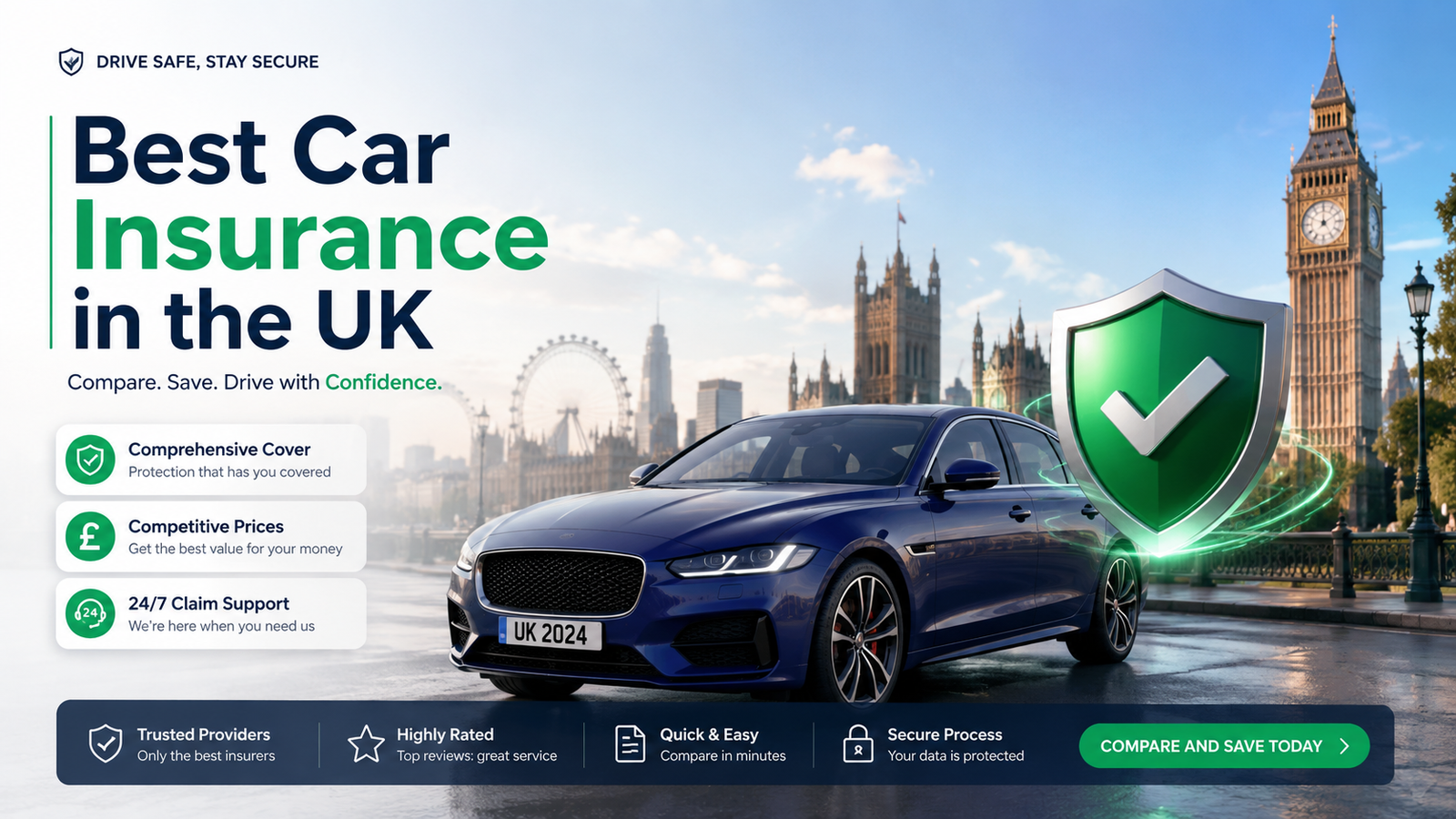
Finding the best car insurance in the UK is one of the most critical financial decisions every driver faces. Whether you are buying your very first car, upgrading to a family SUV, or managing a household fleet, selecting the right insurance policy isn’t just about meeting the legal requirement—it is about ensuring financial protection, seamless claims handling, and peace of mind when the unexpected happens.
With fluctuating premiums, changing FCA (Financial Conduct Authority) regulations, and evolving risk assessment algorithms, navigating the UK car insurance market can feel overwhelming. The UK market is packed with hundreds of insurance providers, broker platforms, and price comparison sites, each claiming to offer “cheap quotes” and “unbeatable cover.”
In this comprehensive guide, we will unpack everything you need to know about UK motor insurance. From analyzing top-rated providers to breaking down policy tiers, explaining hidden policy clauses, and revealing actionable strategies to slash your annual premium, this guide covers it all.
Table of Contents
- Understanding the UK Car Insurance Market
- Types of Coverage: Selecting the Best Car Insurance in the UK
- Top 7 Best Car Insurance Providers in the UK Reviewed
- Tailored Advice: Finding the Best Car Insurance in the UK for Every Driver Profile
- How Insurers Calculate Your UK Car Insurance Premium
- 10 Proven Strategies to Get the Best Car Insurance in the UK for Less
- Policy Add-Ons & Extras: Which Ones Are Worth Your Money?
- Understanding the Claims Process Step-by-Step
- Legal Nuances: No Claims Discount (NCD), Fronting, & Telematics
- Frequently Asked Questions (FAQs)
1. Understanding the UK Car Insurance Market
Under the Road Traffic Act 1988, it is a legal requirement to have valid motor insurance if you drive or keep a vehicle in a public place in the UK. Driving without insurance is a serious offense that carries severe penalties, including:
- An immediate fixed penalty of £300.
- 6 penalty points on your driving license.
- Potential unlimited fines if the case goes to court.
- Disqualification from driving and vehicle impoundment.
Because insurance is legally mandated, the UK market is heavily regulated by the Financial Conduct Authority (FCA) and the Prudential Regulation Authority (PRA). The FCA enforces strict rules to ensure consumers are treated fairly. One major policy shift introduced in recent years is the FCA Price Walking Ban, which prevents insurers from charging existing renewing customers higher prices than new customers for the same risk profile.
Despite this rule, prices fluctuate based on broader market dynamics, including inflation, rising repair costs for modern electric and hybrid vehicles, and the increasing complexity of vehicle technology like sensors and digital dashboards.
2. Types of Coverage: Selecting the Best Car Insurance in the UK
When shopping for the best car insurance in the UK, you must choose between three primary cover levels. Understanding these options is essential so you don’t end up under-insured or overpaying for unnecessary coverage.
+---------------------------------------------------------------------------------+
|                         LEVELS OF CAR INSURANCE COVERAGE                         |
+---------------------------------------------------------------------------------+
|  Third-Party Only (TPO)         |  Covers damage/injury to OTHERS only.         |
|  Third-Party, Fire & Theft     |  TPO + covers YOUR car for theft or fire damage.|
|  Fully Comprehensive            |  Full cover for OTHERS + YOUR car in all events.|
+---------------------------------------------------------------------------------+
A. Third-Party Only (TPO)
Third-Party Only is the minimum level of cover permitted by UK law.
- What it covers: Damage to other people’s vehicles, property damage, and personal injury compensation to third parties (passengers, pedestrian, or other drivers) if an accident is your fault.
- What it misses: Any damage to your own vehicle or personal medical expenses if you cause an accident.
- Common Misconception: Many drivers assume TPO is the cheapest option. In reality, insurance algorithms view drivers selecting TPO as higher-risk individuals. As a result, Comprehensive insurance is frequently cheaper than Third-Party Only.
B. Third-Party, Fire & Theft (TPFT)
TPFT provides the same base level of liability protection as TPO, with additional coverage for your own vehicle in specific circumstances.
- What it covers: All third-party damage, plus repairs or a market-value payout if your car is stolen, damaged during an attempted theft, or damaged by fire.
- Best suited for: Owners of older cars with low market values who want protection against theft or fire, but aren’t concerned with cosmetic or accidental bodywork repairs.
C. Fully Comprehensive Coverage
Fully Comprehensive insurance offers the highest level of financial protection available on UK roads.
- What it covers: Everything covered under TPFT, plus accidental damage to your own vehicle—even if the collision was entirely your fault or if you cannot identify the party responsible (e.g., hit-and-run incidents or vandalism in a parking lot).
- Key Extras: Often includes glass/windscreen repair, medical expenses, personal belongings cover, and a courtesy car while yours is in the repair shop.
3. Top 7 Best Car Insurance Providers in the UK Reviewed
To help you navigate the landscape, we have analyzed the UK’s leading car insurance companies based on policy features, customer satisfaction scores, claims processing efficiency, and overall value for money.
+------------------------------------------------------------------------------------+
|                         TOP UK CAR INSURERS COMPARISON MATRIX                      |
+------------------------------------------------------------------------------------+
| Provider        | Standout Feature           | Customer Rating | Best For          |
+-----------------+----------------------------+-----------------+-------------------+
| Aviva           | Defaqto 5-Star Cover       | 4.5 / 5         | Overall Quality   |
| Admiral         | Multi-Car Discounts        | 4.3 / 5         | Families/Fleet    |
| LV=             | Exceptional Claims Handling| 4.6 / 5         | Customer Care     |
| Direct Line     | No Comparison Site Fees    | 4.2 / 5         | Fair Pricing      |
| Saga            | 3-Year Fixed Price Option  | 4.7 / 5         | Over-50s Drivers  |
| Hastings Direct | Budget Pricing Tiers       | 4.1 / 5         | Value Seeker      |
| NFU Mutual      | Award-Winning Loyalty      | 4.8 / 5         | Rural/Low Mileage |
+------------------------------------------------------------------------------------+
1. Aviva — Best Overall Quality & Reliability
Aviva is the UK’s largest general insurer and consistently scores high marks across industry ratings like Defaqto and Which?.
- Key Benefits: Up to 15% discount for insuring multiple cars; uninsured driver promise (protects your excess and No Claims Discount if hit by an uninsured driver); 3-year repair guarantee using approved repairers.
- Drawbacks: Can be slightly more expensive than budget brokers if you don’t take advantage of multi-product discounts.
2. Admiral — Best for Multi-Car Households
Admiral is a powerhouse in the UK car insurance sector, renowned for pioneering the Multi-Car insurance framework.
- Key Benefits: Allows you to combine up to 6 vehicles under one master policy; flexible renewal dates for different cars; generous discounts per added vehicle; includes courtesy cars as standard on comprehensive plans.
- Drawbacks: High cancellation fees and administrative charges if you make policy modifications midway through your term.
3. LV= (Liverpool Victoria) — Best for Customer Care
LV= is widely praised for its empathetic, efficient, and user-friendly claims processing team, making it a top choice for drivers who prioritize peace of mind.
- Key Benefits: Excellent Trustpilot ratings; lifetime guarantee on repairs for as long as you own the car (when using their approved repairer network); standard coverage for personal belongings and child car seats.
- Drawbacks: Not always the lowest baseline quote for drivers under the age of 25.
4. Direct Line — Best Standalone Direct Insurer
Direct Line famously avoids comparison websites like Go.Compare and MoneySuperMarket, opting to deal directly with consumers to save on aggregator fees and pass savings along.
- Key Benefits: “On-the-move” guarantee (provides taxi transport or onward travel if your car is unusable after an accident); fair claim commitment; strong electric vehicle (EV) battery and cable coverage.
- Drawbacks: You must go directly to their website to obtain a quote, as they will not appear on comparison search engines.
5. Saga — Best for Drivers Over 50
Saga specializes strictly in products tailored for mature motorists aged 50 and above.
- Key Benefits: Unmatched stability features like their 3-Year Fixed Price guarantee (your premium stays flat even if you make a claim, provided policy details don’t change); zero cancellation fees on high-tier plans; includes emergency medical cover and driver handoff cover.
- Drawbacks: Strictly restricted to drivers aged 50 and older.
6. Hastings Direct — Best for Budget-Conscious Motorists
Hastings Direct operates heavily across comparison platforms, offering tiered plans (Hastings Essential, Hastings Direct, and Hastings Premier) to accommodate different budgets.
- Key Benefits: Low entry-level pricing; excellent digital app interface for policy management; flexible option to add telematics via their YouDrive brand.
- Drawbacks: The entry-tier “Essential” cover strips away basic features like windscreen cover and courtesy cars, which must be purchased as add-ons.
7. NFU Mutual — Best for Rural Drivers & Customer Loyalty
Originally created for farmers, NFU Mutual consistently wins customer satisfaction surveys due to its local branch system and claims payout ratios.
- Key Benefits: Mutual bonus discounts for loyal policyholders; local offices across the UK for face-to-face interaction; no excessive admin fees for policy edits.
- Drawbacks: Requires contacting local branches or agent platforms for tailored quotes; rarely competes on raw low-budget pricing.
4. Tailored Advice: Finding the Best Car Insurance in the UK for Every Driver Profile
Your personal demographic profile directly dictates which insurance policies will offer the best value.
Best Car Insurance in the UK for Young Drivers (Ages 17–24)
Young drivers face steep statistical hurdles due to higher accident involvement rates. Average premiums for 17- to 20-year-olds often range between £1,200 and £2,500+.
- Best Strategy: Look specifically for Telematics (Black Box) Policies. Brands like Marmalade, Hastings YouDrive, and Ingenie monitor driving dynamics (acceleration, cornering, braking, and driving hours). Demonstrating safe habits yields monthly or quarterly refunds and renewal discounts.
- Vehicle Choice: Drive vehicles categorized in Insurance Groups 1 to 5 (e.g., Hyundai i10, Volkswagen Polo, Fiat 500, Ford Fiesta).
Best Car Insurance in the UK for Families & Multi-Vehicle Homes
Managing multiple policies with different expiration dates creates unnecessary hassle and higher costs.
- Best Strategy: Consolidate policies under a single Multi-Car framework (e.g., Admiral or LV=). Multi-car plans allow individual family members to maintain their own No Claims Discounts while unlocking multi-vehicle price reductions ranging between 10% and 25%.
Best Car Insurance in the UK for Electric Vehicle (EV) Drivers
EVs present unique repair requirements, including specialized battery diagnostics, specialized body shop technicians, and high replacement battery costs.
- Best Strategy: Ensure your chosen policy explicitly includes charging cable liability (protects against trip hazards while charging in public), battery recovery/replacement, and EV-specific roadside assistance. Insurers like Aviva, Direct Line, and Churchill lead in comprehensive EV protection packages.
5. How Insurers Calculate Your UK Car Insurance Premium
Insurers rely on sophisticated algorithmic actuarial risk tables to establish your quote. Understanding these risk factors allows you to actively influence them:
+-----------------------------------------------------------------------------------+
|                           PREMIUM PRICING ENGINE                                  |
+-----------------------------------------------------------------------------------+
|  [ Driver Profile ]  +  [ Vehicle Risk ]  +  [ Location Data ]  =  [ Base Premium ] |
|  - Age & Experience     - Insurance Group     - Crime Rates                       |
|  - Occupation           - Security/Alarm      - Accident Rates                    |
|  - Claims History       - Annual Mileage      - Parking Location                  |
+-----------------------------------------------------------------------------------+
- Age & Driving Experience: Statistically, younger and novice drivers submit more frequent and costly claims. Premium costs generally drop significantly once a driver reaches age 25, stabilizes through age 65, and rises slightly past age 75.
- Postcode Location: Where you park your car overnight plays a massive role. High-density urban areas (like Inner London, Manchester, or Birmingham) with higher rates of vehicle theft, vandalism, and traffic congestion attract higher risk scores than quiet rural postcodes.
- Vehicle Insurance Group (1 to 50): Every car model sold in the UK is assigned an official Insurance Group rating from 1 (cheapest) to 50 (most expensive) by Thatcham Research. Ratings consider repair costs, parts availability, engine performance, zero-to-sixty times, and structural safety features.
- Annual Mileage: The more miles you drive per year, the higher your statistical probability of being involved in an incident. However, underestimating your annual mileage drastically is considered fraud and can void your policy during a claim.
- Occupation: Insurers cross-reference job titles against claims databases. Roles involving high stress, late-night driving, or extensive commercial travel (e.g., journalists, sales reps, chefs) carry higher risk scores than office-bound administrative staff.
- Overnight Parking: Parking in a locked garage or on a private driveway reduces collision and theft risk compared to parking on a street corner.
6. 10 Proven Strategies to Get the Best Car Insurance in the UK for Less
If you want to reduce your annual car insurance costs without downgrading your cover, apply these ten actionable, legal strategies:
+----------------------------------------------------------------------------------+
|                            10 WAYS TO CUT CAR INSURANCE                          |
+----------------------------------------------------------------------------------+
|  1. Time Your Purchase (20–26 Days)    |  6. Optimize Your Job Title             |
|  2. Voluntarily Increase Excess        |  7. Fit Approved Security Devices       |
|  3. Combine Policies (Multi-Car)       |  8. Accurately Estimate Annual Mileage  |
|  4. Protect & Build Your NCD           |  9. Avoid Monthly Installment Interest  |
|  5. Add a Low-Risk Named Driver        | 10. Compare Multiple Aggregators        |
+----------------------------------------------------------------------------------+
1. Buy 20 to 26 Days Before Renewal
Timing is everything. Data from price engines shows that purchasing or renewing your policy 20 to 26 days before your expiration date yields the lowest possible price point. Insurers interpret last-minute buying (1 to 3 days before renewal) as erratic, high-risk behavior, raising quotes by up to 40%.
2. Increase Your Voluntary Excess
Excess is the portion of a claim you must pay out of pocket before the insurer covers the rest. It is made up of:
$$\text{Total Excess} = \text{Compulsory Excess} + \text{Voluntary Excess}$$
Raising your voluntary excess from £0 or £100 up to £250 or £500 lowers your annual premium. Just make sure you can afford the total excess if you need to file a claim.
3. Avoid Monthly Payment Plans
Paying your car insurance monthly might seem convenient, but insurers charge interest rates (APR) ranging from 15% to 30% on monthly installments. Paying your premium in full upfront saves you money over the course of the year.
4. Optimize Your Job Title (Truthfully)
Insurers use industry job classifications to determine risk. Minor tweaks in how you describe your job can change your quote significantly. For example, describing yourself as a “Kitchen Assistant” instead of a “Chef” or a “Writer” instead of a “Journalist” can yield lower rates. Always ensure your description remains accurate to avoid invalidating your policy.
5. Add a Low-Risk Named Driver
If you are a young or relatively inexperienced driver, adding a second named driver with a clean driving record and decades of experience (such as a parent) lowers the overall risk calculation for the vehicle.
⚠️ CRITICAL WARNING — DO NOT FRONT: The main driver listed on the policy must be the person who actually drives the vehicle the majority of the time. Claiming an experienced driver is the main driver when a young driver uses the car most is illegal “Fronting”. Fronting is insurance fraud; it voids your policy, leads to denied claims, and results in criminal prosecution.
6. Drive Cars in Low Insurance Groups
Before purchasing your next car, check its insurance group classification. Choosing a vehicle in Group 1 to 10 (like a Ford Fiesta, Skoda Fabia, or VW Up!) will save you hundreds compared to vehicles in Groups 25+.
7. Calculate Your Mileage Accurately
Avoid overestimating your annual driving distance. If you drive 6,000 miles a year, don’t default to the UK average of 10,000 miles. Check your previous MOT certificates to find your precise annual mileage and quote accordingly.
8. Install Approved Security Upgrades
Adding a Thatcham-approved alarm, immobilizer, or GPS tracking device can lower your policy costs—especially for high-value or highly targeted vehicle models.
9. Protect Your No Claims Discount (NCD)
Your No Claims Discount is your most valuable asset in motor insurance. Five or more consecutive claim-free years can drop your renewal rates by up to 60%–70%. Paying a small annual fee to protect your NCD ensures a single fault claim won’t wipe out years of accumulated savings.
10. Cross-Shop Across Multiple Aggregators
Never rely on a single comparison engine. Different comparison websites (e.g., Go.Compare, Confused.com, MoneySuperMarket, Compare the Market) have exclusive commercial partnerships with different insurers. Always compare across at least two major sites and manually run a quote with direct-only providers like Direct Line.
7. Policy Add-Ons & Extras: Which Ones Are Worth Your Money?
When finalizing your quote, insurers will offer several optional policy add-ons. Here is a breakdown of which options offer true value versus those you can safely skip:
+---------------------------------------------------------------------------------+
|                       POLICY ADD-ONS EVALUATION TABLE                           |
+---------------------------------------------------------------------------------+
| Add-On Feature           | Typical Cost   | Verdict & Recommendation            |
+--------------------------+----------------+-------------------------------------+
| Motor Legal Protection   | £20 - £35/yr   | HIGHLY RECOMMENDED for uninsured loss|
| Windscreen Repair Cover  | £15 - £25/yr   | RECOMMENDED (keeps NCD intact)       |
| Breakdown Cover          | £40 - £90/yr   | CONDITIONAL (compare standalone)     |
| Guaranteed Courtesy Car  | £15 - £30/yr   | RECOMMENDED for daily commuters     |
| Key Care Cover           | £15 - £25/yr   | OPTIONAL / SKIP (high margin)        |
+---------------------------------------------------------------------------------+
- Motor Legal Protection (£20–£35/year): Verdict: Highly Recommended. Covers up to £100,000 in legal expenses to recover uninsurable losses following an accident where you were not at fault (e.g., recovering lost earnings, personal injury compensation, and your excess payment).
- Windscreen Cover (£15–£25/year): Verdict: Recommended. Replaces or repairs chipped/cracked glass with minimal excesses without counting as a claim against your No Claims Discount.
- Breakdown Cover (£40–£90/year): Verdict: Conditional. Bundling roadside assistance through your car insurer is convenient, but standalone breakdown providers (like RAC, AA, or Green Flag) or specialized packaged bank accounts often offer broader cover for less money.
- Guaranteed Courtesy Car Cover (£15–£30/year): Verdict: Essential for Commuters. Standard comprehensive policies usually promise a courtesy vehicle only if your car is repairable at an approved body shop. If your car is written off or stolen, standard cover stops. Purchasing guaranteed courtesy car protection ensures you receive a replacement vehicle regardless of the claim outcome.
8. Understanding the Claims Process Step-by-Step
Filing a claim can be stressful. Following a clear procedure ensures your claim is processed quickly and without dispute.
+-----------------------------------------------------------------------------------+
|                           THE 5-STEP CLAIMS PROCESS                               |
+-----------------------------------------------------------------------------------+
|  [Step 1: Safety & Scene Data] -> Stop vehicle, take photo evidence, exchange info|
|  [Step 2: Notify Police]       -> Mandatory within 24 hrs if injuries occur       |
|  [Step 3: Contact Insurer]     -> Call hotline within 24-48 hours                 |
|  [Step 4: Assessment & Repair] -> Approved garage evaluation or write-off payout   |
|  [Step 5: Settlement & Excess] -> Pay excess fee & resolve final claim status     |
+-----------------------------------------------------------------------------------+
Step 1: Secure the Scene and Collect Evidence
If you are involved in a collision:
- Stop immediately. It is an offense under UK law to drive away.
- Switch on hazard lights and ensure all passengers are safe.
- Call Emergency Services (999 or 112) if anyone is injured or if the road is blocked.
- Take photos and video of vehicle damage, road markings, weather conditions, and license plates.
- Exchange details with the other parties: Name, address, phone number, insurer name, and policy number.
- Gather contact details from independent witnesses.
Step 2: Notify the Police (If Required)
You must report the collision to the police within 24 hours if you cannot exchange details at the scene, if property was damaged, or if anyone sustained an injury. Obtain a Police Incident Reference Number.
Step 3: Contact Your Insurance Provider
Notify your insurer as soon as possible (ideally within 24 hours), even if you do not intend to make a claim right away. Most insurers require notification of any incident as a condition of your policy terms.
Step 4: Assessment, Repair, or Write-Off
Your insurer will send your car to an approved repair facility.
- If Repairable: The repair shop uses genuine replacement parts, performs work under guarantee, and provides a courtesy car.
- If Written Off (Category A, B, S, or N): If repair costs exceed the market value of the car, the insurer deems it a write-off. They will pay out the vehicle’s fair market value minus your agreed excess.
9. Legal Nuances: NCD, Fronting, & Telematics Explained
Understanding key regulatory definitions will help you avoid expensive mistakes:
No Claims Discount (NCD)
Your No Claims Discount (also known as a No Claims Bonus) is a reduction applied to your premium for every year you drive without making a claim.
- 1 Year NCD = ~20% discount
- 3 Years NCD = ~40% discount
- 5+ Years NCD = ~60% to 70% discount
- Note: If you make an at-fault claim without NCD Protection, you usually lose 2 years’ worth of accumulated bonus points per claim.
Write-Off Categories (SMMT Standards)
If your car suffers structural or non-structural damage, insurers assign it a write-off code:
- Category A: Total scrap. Vehicle must be destroyed completely; no parts can be salvaged.
- Category B: Body structure must be scrapped, but usable non-structural parts can be salvaged.
- Category S (Structural): Vehicle sustained structural damage but is repairable. Can return to public roads after professional repair.
- Category N (Non-Structural): Vehicle sustained cosmetic, electrical, or non-structural damage and is economically repairable.
10. Frequently Asked Questions (FAQs)
Q1: Is it always cheaper to get car insurance through comparison sites?
Answer: Aggregators like Go.Compare and Confused.com are great starting points, but they don’t cover every provider. Direct-only insurers like Direct Line do not appear on these engines. It is always best to check comparison sites plus direct-only providers to find the best car insurance in the UK for your budget.
Q2: What happens if I forget to cancel my old policy?
Answer: Most UK car insurance policies automatically renew. If your policy auto-renews and you have taken out a new policy with a different company, you run into “Dual Insurance,” which can cause complications during claims. Always explicitly cancel your previous policy before its expiration date. You are entitled to a 14-day statutory cooling-off period with any new insurer, during which you can cancel for a small administration fee.
Q3: Does driving a modified car increase my insurance rate?
Answer: Yes. Modifications—including alloy wheel upgrades, engine remapping, body kits, and exhaust modifications—can increase collision or theft risk, driving up your premium. All modifications (excluding standard manufacturer options) must be declared to your insurer. Failing to disclose modifications can invalidate your policy entirely.
Q4: Can I drive someone else’s car on my comprehensive policy?
Answer: Do not assume your policy includes Driving Other Cars (DOC) cover. While many comprehensive policies previously included DOC automatically for drivers over 25, many modern policies have removed this feature or restricted it to emergency situations. Check your official Certificate of Motor Insurance document to verify if DOC coverage is active.
Q5: Will my UK car insurance cover me when driving in Europe?
Answer: Most UK motor insurance policies automatically include minimum Third-Party coverage across EU member states. However, if you want full Comprehensive cover while driving abroad, you must contact your insurer before traveling to purchase a temporary EU extension add-on.
Final Thoughts: Taking Action Today
Finding the best car insurance in the UK comes down to balancing price, coverage, and customer support. Don’t let your policy auto-renew without shopping around.
- Mark your calendar: Set a reminder 20 to 26 days before your renewal date.
- Gather your details: Know your current No Claims Discount years, precise annual mileage, and vehicle details.
- Run comparison searches: Use at least two major price comparison platforms alongside direct insurers like Direct Line.
- Customize your cover: Adjust your voluntary excess, verify necessary add-ons, and lock in your price early.

Under the Road Traffic Act 1988 on GOV.UK, it is a legal requirement to have valid motor insurance if you drive or keep a vehicle in a public place in the UK. Driving without insurance is a serious offense that carries severe penalties, including:
- An immediate fixed penalty of £300.
- 6 penalty points on your driving license.
- Potential unlimited fines if the case goes to court.
- Disqualification from driving and vehicle impoundment.
Because insurance is legally mandated, the UK market is heavily regulated by the Financial Conduct Authority (FCA) and the Prudential Regulation Authority (PRA). The FCA enforces strict rules to ensure consumers are treated fairly. One major policy shift introduced in recent years is the FCA Price Walking Ban, which prevents insurers from charging existing renewing customers higher prices than new customers for the same risk profile.
Despite this rule, prices fluctuate based on broader market dynamics, including inflation, rising repair costs for modern electric and hybrid vehicles, and the increasing complexity of vehicle technology like sensors and digital dashboards.
When you SHOULD change it to dofollow
Remove the rel="nofollow" tag (making it a standard, followed link) if:
- High-Quality Citation: You are linking to a highly authoritative, relevant, or official resource (like a research paper, official documentation, or a major publication).
- Editorial Endorsement: You genuinely vouch for the page and want to signal to search engines that it’s a helpful reference for your readers.
Quick SEO Tip: Outbound links to high-authority, relevant sources don’t harm your site; in fact, linking out naturally to good sources helps search engines understand your content’s context and topic cluster.
When you SHOULD change it to dofollow
Remove the rel="nofollow" tag (making it a standard, followed link) if:
- High-Quality Citation: You are linking to a highly authoritative, relevant, or official resource (like a research paper, official documentation, or a major publication).
- Editorial Endorsement: You genuinely vouch for the page and want to signal to search engines that it’s a helpful reference for your readers.
Quick SEO Tip: Outbound links to high-authority, relevant sources don’t harm your site; in fact, linking out naturally to good sources helps search engines understand your content’s context and topic cluster.
Finding the best car insurance in the UK is one of the most critical financial decisions every driver faces. Whether you are buying your very first car, upgrading to a family SUV, or managing a household fleet, selecting the right insurance policy isn’t just about meeting the legal requirement—it is about ensuring financial protection, seamless claims handling, and peace of mind when the unexpected happens.
With fluctuating premiums, changing regulations enforced by the Financial Conduct Authority (FCA), and evolving risk assessment algorithms, navigating the UK car insurance market can feel overwhelming. The UK market is packed with hundreds of insurance providers, broker platforms, and price comparison sites, each claiming to offer “cheap quotes” and “unbeatable cover.”
In this comprehensive guide, we will unpack everything you need to know about UK motor insurance. From analyzing top-rated providers to breaking down policy tiers, explaining hidden policy clauses, and revealing actionable strategies to slash your annual premium, this guide covers it all.
Featured SEO Image
Table of Contents
- Understanding the UK Car Insurance Market
- Types of Coverage: Selecting the Best Car Insurance in the UK
- Top 7 Best Car Insurance Providers in the UK Reviewed
- Tailored Advice: Finding the Best Car Insurance in the UK for Every Driver Profile
- How Insurers Calculate Your UK Car Insurance Premium
- 10 Proven Strategies to Get the Best Car Insurance in the UK for Less
- Policy Add-Ons & Extras: Which Ones Are Worth Your Money?
- Understanding the Claims Process Step-by-Step
- Legal Nuances: No Claims Discount (NCD), Fronting, & Telematics
- Frequently Asked Questions (FAQs)
1. Understanding the UK Car Insurance Market
Under the Road Traffic Act 1988 on GOV.UK, it is a legal requirement to have valid motor insurance if you drive or keep a vehicle in a public place in the UK. Driving without insurance is a serious offense that carries severe penalties, including:
- An immediate fixed penalty of £300.
- 6 penalty points on your driving license.
- Potential unlimited fines if the case goes to court.
- Disqualification from driving and vehicle impoundment.
Because insurance is legally mandated, the UK market is heavily regulated by the Financial Conduct Authority (FCA) and the Prudential Regulation Authority (PRA). The FCA enforces strict rules to ensure consumers are treated fairly. One major policy shift introduced in recent years is the FCA Price Walking Ban, which prevents insurers from charging existing renewing customers higher prices than new customers for the same risk profile.
Despite this rule, prices fluctuate based on broader market dynamics, including inflation, rising repair costs for modern electric and hybrid vehicles, and the increasing complexity of vehicle technology like sensors and digital dashboards.
2. Types of Coverage: Selecting the Best Car Insurance in the UK
When shopping for the best car insurance in the UK, you must choose between three primary cover levels. Understanding these options is essential so you don’t end up under-insured or overpaying for unnecessary coverage.
+---------------------------------------------------------------------------------+
|                         LEVELS OF CAR INSURANCE COVERAGE                         |
+---------------------------------------------------------------------------------+
|  Third-Party Only (TPO)         |  Covers damage/injury to OTHERS only.         |
|  Third-Party, Fire & Theft     |  TPO + covers YOUR car for theft or fire damage.|
|  Fully Comprehensive            |  Full cover for OTHERS + YOUR car in all events.|
+---------------------------------------------------------------------------------+
A. Third-Party Only (TPO)
Third-Party Only is the minimum level of cover permitted by UK law.
- What it covers: Damage to other people’s vehicles, property damage, and personal injury compensation to third parties (passengers, pedestrian, or other drivers) if an accident is your fault.
- What it misses: Any damage to your own vehicle or personal medical expenses if you cause an accident.
- Common Misconception: Many drivers assume TPO is the cheapest option. In reality, insurance algorithms view drivers selecting TPO as higher-risk individuals. As a result, Comprehensive insurance is frequently cheaper than Third-Party Only.
B. Third-Party, Fire & Theft (TPFT)
TPFT provides the same base level of liability protection as TPO, with additional coverage for your own vehicle in specific circumstances.
- What it covers: All third-party damage, plus repairs or a market-value payout if your car is stolen, damaged during an attempted theft, or damaged by fire.
- Best suited for: Owners of older cars with low market values who want protection against theft or fire, but aren’t concerned with cosmetic or accidental bodywork repairs.
C. Fully Comprehensive Coverage
Fully Comprehensive insurance offers the highest level of financial protection available on UK roads.
- What it covers: Everything covered under TPFT, plus accidental damage to your own vehicle—even if the collision was entirely your fault or if you cannot identify the party responsible (e.g., hit-and-run incidents or vandalism in a parking lot).
- Key Extras: Often includes glass/windscreen repair, medical expenses, personal belongings cover, and a courtesy car while yours is in the repair shop.
3. Top 7 Best Car Insurance Providers in the UK Reviewed
To help you navigate the landscape, we have analyzed the UK’s leading car insurance companies based on policy features, customer satisfaction scores, claims processing efficiency, and independent star ratings from Defaqto Ratings.
+------------------------------------------------------------------------------------+
|                         TOP UK CAR INSURERS COMPARISON MATRIX                      |
+------------------------------------------------------------------------------------+
| Provider        | Standout Feature           | Customer Rating | Best For          |
+-----------------+----------------------------+-----------------+-------------------+
| Aviva           | Defaqto 5-Star Cover       | 4.5 / 5         | Overall Quality   |
| Admiral         | Multi-Car Discounts        | 4.3 / 5         | Families/Fleet    |
| LV=             | Exceptional Claims Handling| 4.6 / 5         | Customer Care     |
| Direct Line     | No Comparison Site Fees    | 4.2 / 5         | Fair Pricing      |
| Saga            | 3-Year Fixed Price Option  | 4.7 / 5         | Over-50s Drivers  |
| Hastings Direct | Budget Pricing Tiers       | 4.1 / 5         | Value Seeker      |
| NFU Mutual      | Award-Winning Loyalty      | 4.8 / 5         | Rural/Low Mileage |
+------------------------------------------------------------------------------------+
1. Aviva — Best Overall Quality & Reliability
Aviva is the UK’s largest general insurer and consistently scores high marks across industry ratings like Defaqto and Which?.
- Key Benefits: Up to 15% discount for insuring multiple cars; uninsured driver promise (protects your excess and No Claims Discount if hit by an uninsured driver); 3-year repair guarantee using approved repairers.
- Drawbacks: Can be slightly more expensive than budget brokers if you don’t take advantage of multi-product discounts.
2. Admiral — Best for Multi-Car Households
Admiral is a powerhouse in the UK car insurance sector, renowned for pioneering the Multi-Car insurance framework.
- Key Benefits: Allows you to combine up to 6 vehicles under one master policy; flexible renewal dates for different cars; generous discounts per added vehicle; includes courtesy cars as standard on comprehensive plans.
- Drawbacks: High cancellation fees and administrative charges if you make policy modifications midway through your term.
3. LV= (Liverpool Victoria) — Best for Customer Care
LV= is widely praised for its empathetic, efficient, and user-friendly claims processing team, making it a top choice for drivers who prioritize peace of mind.
- Key Benefits: Excellent Trustpilot ratings; lifetime guarantee on repairs for as long as you own the car (when using their approved repairer network); standard coverage for personal belongings and child car seats.
- Drawbacks: Not always the lowest baseline quote for drivers under the age of 25.
4. Direct Line — Best Standalone Direct Insurer
Direct Line famously avoids comparison websites like Go.Compare and MoneySuperMarket, opting to deal directly with consumers to save on aggregator fees and pass savings along.
- Key Benefits: “On-the-move” guarantee (provides taxi transport or onward travel if your car is unusable after an accident); fair claim commitment; strong electric vehicle (EV) battery and cable coverage.
- Drawbacks: You must go directly to their website to obtain a quote, as they will not appear on comparison search engines.
5. Saga — Best for Drivers Over 50
Saga specializes strictly in products tailored for mature motorists aged 50 and above.
- Key Benefits: Unmatched stability features like their 3-Year Fixed Price guarantee (your premium stays flat even if you make a claim, provided policy details don’t change); zero cancellation fees on high-tier plans; includes emergency medical cover and driver handoff cover.
- Drawbacks: Strictly restricted to drivers aged 50 and older.
6. Hastings Direct — Best for Budget-Conscious Motorists
Hastings Direct operates heavily across comparison platforms, offering tiered plans (Hastings Essential, Hastings Direct, and Hastings Premier) to accommodate different budgets.
- Key Benefits: Low entry-level pricing; excellent digital app interface for policy management; flexible option to add telematics via their YouDrive brand.
- Drawbacks: The entry-tier “Essential” cover strips away basic features like windscreen cover and courtesy cars, which must be purchased as add-ons.
7. NFU Mutual — Best for Rural Drivers & Customer Loyalty
Originally created for farmers, NFU Mutual consistently wins customer satisfaction surveys due to its local branch system and claims payout ratios.
- Key Benefits: Mutual bonus discounts for loyal policyholders; local offices across the UK for face-to-face interaction; no excessive admin fees for policy edits.
- Drawbacks: Requires contacting local branches or agent platforms for tailored quotes; rarely competes on raw low-budget pricing.
4. Tailored Advice: Finding the Best Car Insurance in the UK for Every Driver Profile
Your personal demographic profile directly dictates which insurance policies will offer the best value.
Best Car Insurance in the UK for Young Drivers (Ages 17–24)
Young drivers face steep statistical hurdles due to higher accident involvement rates. Average premiums for 17- to 20-year-olds often range between £1,200 and £2,500+.
- Best Strategy: Look specifically for Telematics (Black Box) Policies. Brands like Marmalade, Hastings YouDrive, and Ingenie monitor driving dynamics (acceleration, cornering, braking, and driving hours). Demonstrating safe habits yields monthly or quarterly refunds and renewal discounts. (Read our complete guide on cheap car insurance for young drivers for more strategies).
- Vehicle Choice: Drive vehicles categorized in low risk bands. You can check official ratings on Thatcham Research Group Ratings.
Best Car Insurance in the UK for Families & Multi-Vehicle Homes
Managing multiple policies with different expiration dates creates unnecessary hassle and higher costs.
- Best Strategy: Consolidate policies under a single Multi-Car framework (e.g., Admiral or LV=). Multi-car plans allow individual family members to maintain their own No Claims Discounts while unlocking multi-vehicle price reductions ranging between 10% and 25%.
Best Car Insurance in the UK for Electric Vehicle (EV) Drivers
EVs present unique repair requirements, including specialized battery diagnostics, specialized body shop technicians, and high replacement battery costs.
- Best Strategy: Ensure your chosen policy explicitly includes charging cable liability (protects against trip hazards while charging in public), battery recovery/replacement, and EV-specific roadside assistance. Insurers like Aviva, Direct Line, and Churchill lead in comprehensive EV protection packages.
5. How Insurers Calculate Your UK Car Insurance Premium
Insurers rely on sophisticated algorithmic actuarial risk tables to establish your quote. Understanding these risk factors allows you to actively influence them:
+-----------------------------------------------------------------------------------+
|                           PREMIUM PRICING ENGINE                                  |
+-----------------------------------------------------------------------------------+
|  [ Driver Profile ]  +  [ Vehicle Risk ]  +  [ Location Data ]  =  [ Base Premium ] |
|  - Age & Experience     - Insurance Group     - Crime Rates                       |
|  - Occupation           - Security/Alarm      - Accident Rates                    |
|  - Claims History       - Annual Mileage      - Parking Location                  |
+-----------------------------------------------------------------------------------+
- Age & Driving Experience: Statistically, younger and novice drivers submit more frequent and costly claims. Premium costs generally drop significantly once a driver reaches age 25, stabilizes through age 65, and rises slightly past age 75.
- Postcode Location: Where you park your car overnight plays a massive role. High-density urban areas (like Inner London, Manchester, or Birmingham) with higher rates of vehicle theft, vandalism, and traffic congestion attract higher risk scores than quiet rural postcodes.
- Vehicle Insurance Group (1 to 50): Every car model sold in the UK is assigned an official Insurance Group rating from 1 (cheapest) to 50 (most expensive) by Thatcham Research. Ratings consider repair costs, parts availability, engine performance, zero-to-sixty times, and structural safety features.
- Annual Mileage: The more miles you drive per year, the higher your statistical probability of being involved in an incident. However, underestimating your annual mileage drastically is considered fraud and can void your policy during a claim.
- Occupation: Insurers cross-reference job titles against claims databases. Roles involving high stress, late-night driving, or extensive commercial travel (e.g., journalists, sales reps, chefs) carry higher risk scores than office-bound administrative staff.
- Overnight Parking: Parking in a locked garage or on a private driveway reduces collision and theft risk compared to parking on a street corner.
6. 10 Proven Strategies to Get the Best Car Insurance in the UK for Less
If you want to reduce your annual car insurance costs without downgrading your cover, apply these ten actionable, legal strategies:
+----------------------------------------------------------------------------------+
|                            10 WAYS TO CUT CAR INSURANCE                          |
+----------------------------------------------------------------------------------+
|  1. Time Your Purchase (20–26 Days)    |  6. Optimize Your Job Title             |
|  2. Voluntarily Increase Excess        |  7. Fit Approved Security Devices       |
|  3. Combine Policies (Multi-Car)       |  8. Accurately Estimate Annual Mileage  |
|  4. Protect & Build Your NCD           |  9. Avoid Monthly Installment Interest  |
|  5. Add a Low-Risk Named Driver        | 10. Compare Multiple Aggregators        |
+----------------------------------------------------------------------------------+
1. Buy 20 to 26 Days Before Renewal
Timing is everything. Consumer guidance from sources like MoneySavingExpert Motor Insurance Guide shows that purchasing or renewing your policy 20 to 26 days before your expiration date yields the lowest possible price point. Insurers interpret last-minute buying (1 to 3 days before renewal) as erratic, high-risk behavior, raising quotes by up to 40%.
2. Increase Your Voluntary Excess
Excess is the portion of a claim you must pay out of pocket before the insurer covers the rest. It is made up of:
$$\text{Total Excess} = \text{Compulsory Excess} + \text{Voluntary Excess}$$
Raising your voluntary excess from £0 or £100 up to £250 or £500 lowers your annual premium. Just make sure you can afford the total excess if you need to file a claim.
3. Avoid Monthly Payment Plans
Paying your car insurance monthly might seem convenient, but insurers charge interest rates (APR) ranging from 15% to 30% on monthly installments. Paying your premium in full upfront saves you money over the course of the year.
4. Optimize Your Job Title (Truthfully)
Insurers use industry job classifications to determine risk. Minor tweaks in how you describe your job can change your quote significantly. For example, describing yourself as a “Kitchen Assistant” instead of a “Chef” or a “Writer” instead of a “Journalist” can yield lower rates. Always ensure your description remains accurate to avoid invalidating your policy.
5. Add a Low-Risk Named Driver
If you are a young or relatively inexperienced driver, adding a second named driver with a clean driving record and decades of experience (such as a parent) lowers the overall risk calculation for the vehicle.
⚠️ CRITICAL WARNING — DO NOT FRONT: The main driver listed on the policy must be the person who actually drives the vehicle the majority of the time. Claiming an experienced driver is the main driver when a young driver uses the car most is illegal “Fronting”. Fronting is insurance fraud; it voids your policy, leads to denied claims, and results in criminal prosecution.
6. Drive Cars in Low Insurance Groups
Before purchasing your next car, check its insurance group classification. Choosing a vehicle in Group 1 to 10 (like a Ford Fiesta, Skoda Fabia, or VW Up!) will save you hundreds compared to vehicles in Groups 25+. Check our breakdown of cheapest cars to insure in the UK before making a purchase.
7. Calculate Your Mileage Accurately
Avoid overestimating your annual driving distance. If you drive 6,000 miles a year, don’t default to the UK average of 10,000 miles. Check your previous MOT history on GOV.UK MOT History Checker to find your precise annual mileage and quote accordingly.
8. Install Approved Security Upgrades
Adding a Thatcham-approved alarm, immobilizer, or GPS tracking device can lower your policy costs—especially for high-value or highly targeted vehicle models.
9. Protect Your No Claims Discount (NCD)
Your No Claims Discount is your most valuable asset in motor insurance. Five or more consecutive claim-free years can drop your renewal rates by up to 60%–70%. Paying a small annual fee to protect your NCD ensures a single fault claim won’t wipe out years of accumulated savings.
10. Cross-Shop Across Multiple Aggregators
Never rely on a single comparison engine. Different comparison websites have exclusive commercial partnerships with different insurers. Always compare across multiple major sites and manually run a quote with direct-only providers like Direct Line.
7. Policy Add-Ons & Extras: Which Ones Are Worth Your Money?
When finalizing your quote, insurers will offer several optional policy add-ons. Here is a breakdown of which options offer true value versus those you can safely skip:
+---------------------------------------------------------------------------------+
|                       POLICY ADD-ONS EVALUATION TABLE                           |
+---------------------------------------------------------------------------------+
| Add-On Feature           | Typical Cost   | Verdict & Recommendation            |
+--------------------------+----------------+-------------------------------------+
| Motor Legal Protection   | £20 - £35/yr   | HIGHLY RECOMMENDED for uninsured loss|
| Windscreen Repair Cover  | £15 - £25/yr   | RECOMMENDED (keeps NCD intact)       |
| Breakdown Cover          | £40 - £90/yr   | CONDITIONAL (compare standalone)     |
| Guaranteed Courtesy Car  | £15 - £30/yr   | RECOMMENDED for daily commuters     |
| Key Care Cover           | £15 - £25/yr   | OPTIONAL / SKIP (high margin)        |
+---------------------------------------------------------------------------------+
- Motor Legal Protection (£20–£35/year): Verdict: Highly Recommended. Covers up to £100,000 in legal expenses to recover uninsurable losses following an accident where you were not at fault (e.g., recovering lost earnings, personal injury compensation, and your excess payment).
- Windscreen Cover (£15–£25/year): Verdict: Recommended. Replaces or repairs chipped/cracked glass with minimal excesses without counting as a claim against your No Claims Discount.
- Breakdown Cover (£40–£90/year): Verdict: Conditional. Bundling roadside assistance through your car insurer is convenient, but standalone breakdown providers (like RAC, AA, or Green Flag) or specialized packaged bank accounts often offer broader cover for less money.
- Guaranteed Courtesy Car Cover (£15–£30/year): Verdict: Essential for Commuters. Standard comprehensive policies usually promise a courtesy vehicle only if your car is repairable at an approved body shop. If your car is written off or stolen, standard cover stops. Purchasing guaranteed courtesy car protection ensures you receive a replacement vehicle regardless of the claim outcome.
8. Understanding the Claims Process Step-by-Step
Filing a claim can be stressful. Following a clear procedure ensures your claim is processed quickly and without dispute.
+-----------------------------------------------------------------------------------+
|                           THE 5-STEP CLAIMS PROCESS                               |
+-----------------------------------------------------------------------------------+
|  [Step 1: Safety & Scene Data] -> Stop vehicle, take photo evidence, exchange info|
|  [Step 2: Notify Police]       -> Mandatory within 24 hrs if injuries occur       |
|  [Step 3: Contact Insurer]     -> Call hotline within 24-48 hours                 |
|  [Step 4: Assessment & Repair] -> Approved garage evaluation or write-off payout   |
|  [Step 5: Settlement & Excess] -> Pay excess fee & resolve final claim status     |
+-----------------------------------------------------------------------------------+
Step 1: Secure the Scene and Collect Evidence
If you are involved in a collision:
- Stop immediately. It is an offense under UK law to drive away.
- Switch on hazard lights and ensure all passengers are safe.
- Call Emergency Services (999 or 112) if anyone is injured or if the road is blocked.
- Take photos and video of vehicle damage, road markings, weather conditions, and license plates.
- Exchange details with the other parties: Name, address, phone number, insurer name, and policy number.
- Gather contact details from independent witnesses.
Step 2: Notify the Police (If Required)
You must report the collision to the police within 24 hours if you cannot exchange details at the scene, if property was damaged, or if anyone sustained an injury. Obtain a Police Incident Reference Number.
Step 3: Contact Your Insurance Provider
Notify your insurer as soon as possible (ideally within 24 hours), even if you do not intend to make a claim right away. Most insurers require notification of any incident as a condition of your policy terms. If a dispute arises over a claim settlement, drivers can escalate unresolved issues to the Financial Ombudsman Service. (Learn how to navigate disputing a claim with our step-by-step car insurance claims guide).
Step 4: Assessment, Repair, or Write-Off
Your insurer will send your car to an approved repair facility.
- If Repairable: The repair shop uses genuine replacement parts, performs work under guarantee, and provides a courtesy car.
- If Written Off (Category A, B, S, or N): If repair costs exceed the market value of the car, the insurer deems it a write-off. They will pay out the vehicle’s fair market value minus your agreed excess.
9. Legal Nuances: NCD, Fronting, & Telematics Explained
Understanding key regulatory definitions will help you avoid expensive mistakes:
No Claims Discount (NCD)
Your No Claims Discount (also known as a No Claims Bonus) is a reduction applied to your premium for every year you drive without making a claim.
- 1 Year NCD = ~20% discount
- 3 Years NCD = ~40% discount
- 5+ Years NCD = ~60% to 70% discount
- Note: If you make an at-fault claim without NCD Protection, you usually lose 2 years’ worth of accumulated bonus points per claim.
Write-Off Categories (SMMT Standards)
If your car suffers structural or non-structural damage, insurers assign it a write-off code defined by industry bodies like the Society of Motor Manufacturers and Traders (SMMT):
- Category A: Total scrap. Vehicle must be destroyed completely; no parts can be salvaged.
- Category B: Body structure must be scrapped, but usable non-structural parts can be salvaged.
- Category S (Structural): Vehicle sustained structural damage but is repairable. Can return to public roads after professional repair.
- Category N (Non-Structural): Vehicle sustained cosmetic, electrical, or non-structural damage and is economically repairable.
10. Frequently Asked Questions (FAQs)
Q1: Is it always cheaper to get car insurance through comparison sites?
Answer: Aggregators are great starting points, but they don’t cover every provider. Direct-only insurers like Direct Line do not appear on these engines. It is always best to check comparison sites plus direct-only providers to find the best car insurance in the UK for your budget.
Q2: What happens if I forget to cancel my old policy?
Answer: Most UK car insurance policies automatically renew. If your policy auto-renews and you have taken out a new policy with a different company, you run into “Dual Insurance,” which can cause complications during claims. Always explicitly cancel your previous policy before its expiration date. You are entitled to a 14-day statutory cooling-off period with any new insurer, during which you can cancel for a small administration fee.
Q3: Does driving a modified car increase my insurance rate?
Answer: Yes. Modifications—including alloy wheel upgrades, engine remapping, body kits, and exhaust modifications—can increase collision or theft risk, driving up your premium. All modifications (excluding standard manufacturer options) must be declared to your insurer. Failing to disclose modifications can invalidate your policy entirely.
Q4: Can I drive someone else’s car on my comprehensive policy?
Answer: Do not assume your policy includes Driving Other Cars (DOC) cover. While many comprehensive policies previously included DOC automatically for drivers over 25, many modern policies have removed this feature or restricted it to emergency situations. Check your official Certificate of Motor Insurance document to verify if DOC coverage is active.
Q5: Will my UK car insurance cover me when driving in Europe?
Answer: Most UK motor insurance policies automatically include minimum Third-Party coverage across EU member states. However, if you want full Comprehensive cover while driving abroad, you must contact your insurer before traveling to purchase a temporary EU extension add-on.
Final Thoughts: Taking Action Today
Finding the best car insurance in the UK comes down to balancing price, coverage, and customer support. Don’t let your policy auto-renew without shopping around.
- Mark your calendar: Set a reminder 20 to 26 days before your renewal date.
- Gather your details: Know your current No Claims Discount years, precise annual mileage, and vehicle details.
- Run comparison searches: Use at least two major price comparison platforms alongside direct insurers like Direct Line.
- Customize your cover: Adjust your voluntary excess, verify necessary add-ons, and lock in your price early.
By taking control of your policy renewal using these strategies, you can secure the right protection for your vehicle while keeping your annual costs as low as possible.
Related Read: Before choosing your vehicle cover, explore our detailed breakdown on UK Property & Personal Asset Protection Guide .
Why You Need the Best Car Insurance in the UK” Section
Why Choosing the Best Car Insurance in the UK Matters in 2026
Driving conditions, vehicle repair costs, and insurance underwriting models have changed significantly across England, Scotland, Wales, and Northern Ireland. Selecting the best car insurance in the UK gives you access to key benefits like courtesy cars, windscreen repair, and emergency roadside assistance. Furthermore, drivers who evaluate the best car insurance in the UK options carefully can protect their No Claims Discount (NCD) while keeping annual policy renewal costs manageable.
Leave a Reply