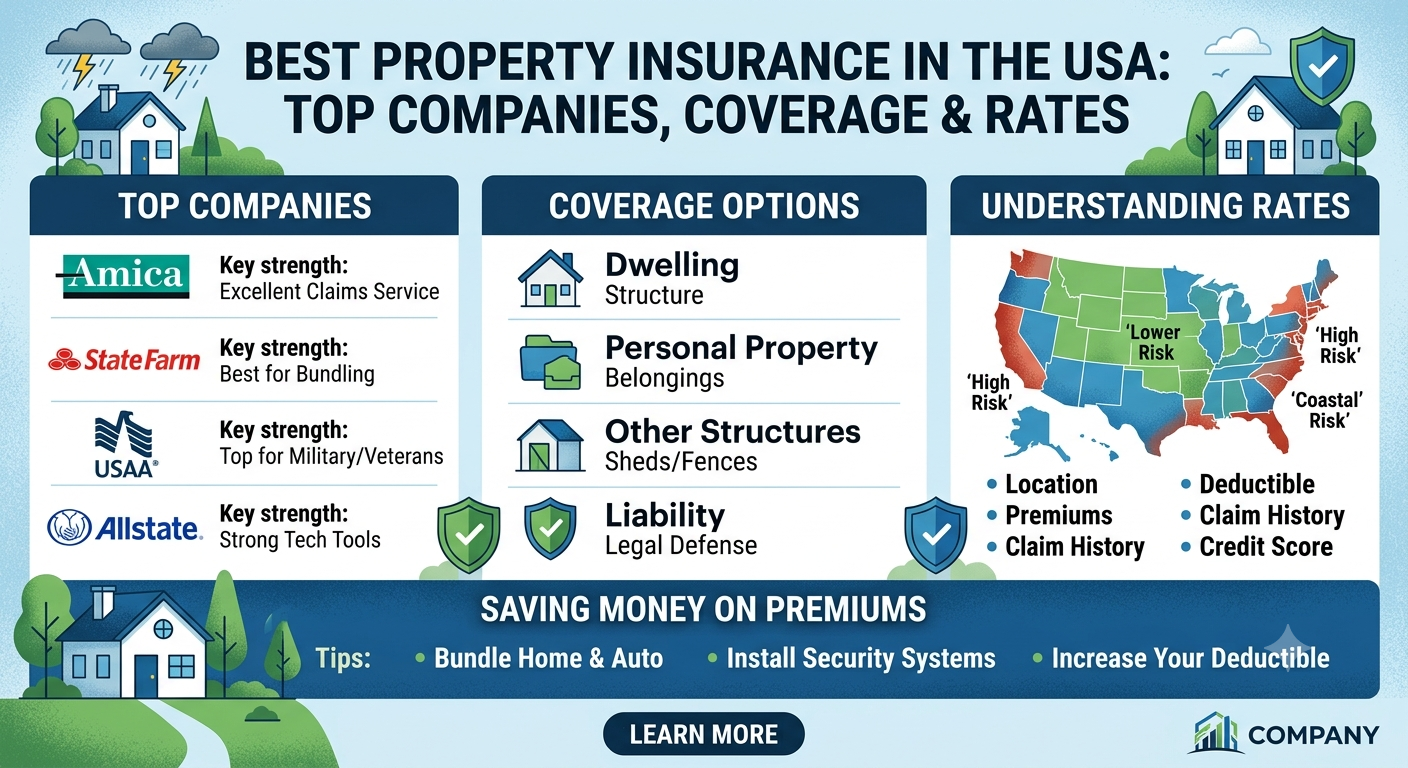
Finding the best property insurance in the USA: top companies, coverage & rates is one of the most critical financial decisions any homeowner, landlord, or real estate owner can make. Property insurance serves as a essential safeguard for your physical structure, personal possessions, and personal liability against unexpected events like storms, fires, theft, and liability lawsuits. However, with national average premiums hovering around $2,151 to $2,543 annually for $300,000–$350,000 in dwelling coverage—and rates fluctuating drastically by state—navigating the insurance market requires a clear understanding of what top carriers offer.
Whether you are buying your first family residence, protecting a multi-unit rental property, or reviewing an existing policy to offset rising inflation, choosing the right insurer involves balancing customer satisfaction, financial stability ratings, tailored coverage options, and cost. This ultimate guide reviews the leading property insurance providers in the United States, breaks down standard policy coverage forms, examines average state rates, and provides actionable strategies to lower your insurance costs without sacrificing protection.
What Is Property Insurance and Why Is It Essential?
Property insurance is an umbrella term that encompasses several policy types designed to protect real property and personal belongings against specified perils. The most common form is standard homeowners insurance (HO-3 policy), but property insurance also includes landlord insurance (DP-3), condo insurance (HO-6), renters insurance (HO-4), and commercial property insurance.
If you finance a home with a mortgage, your lender will mandate property insurance to protect their financial stake in the collateral. However, even if your mortgage is fully paid off, maintaining adequate property insurance protects you from catastrophic out-of-pocket losses caused by destructive weather, structural fires, or severe liability claims.
┌────────────────────────────────────────────────────────────────────────┐
│                   STANDARD PROPERTY INSURANCE COVERAGE                  │
├───────────────┬─────────────────┬──────────────────┬───────────────────┤
│ Dwelling      │ Other Structures│ Personal Property│ Liability &       │
│ Coverage (A)  │ Coverage (B)    │ Coverage (C)     │ Medical Payments  │
└───────────────┴─────────────────┴──────────────────┴───────────────────┘
Top 6 Property Insurance Companies in the USA
To select the top property insurers in the nation, we evaluated financial strength ratings from A.M. Best, customer satisfaction scores from J.D. Power, policy endorsement options, claims processing speed, and rate competitiveness.
| Insurance Company | J.D. Power Rating | A.M. Best Rating | Standout Feature / Best For | Average Premium Range |
| Amica Mutual | 5/5 (Top Rated) | A+ (Superior) | Best Overall Customer Service & Claims | $1,800 – $2,600/yr |
| State Farm | 4/5 | A++ (Superior) | Best for Bundling & Agent Network | $1,500 – $2,300/yr |
| Allstate | 3/5 | A+ (Superior) | Best Digital Tools & Rate Locks | $1,600 – $2,500/yr |
| USAA | 5/5 (Unranked*) | A++ (Superior) | Best for Military Members & Veterans | $1,400 – $2,200/yr |
| Chubb | 2/5 (Niche) | A++ (Superior) | Best for High-Value Homes & Luxury Properties | $3,500+ /yr |
| Progressive / Liberty Mutual | 3/5 | A (Excellent) | Best Choice of Endorsements & Discounts | $1,700 – $2,700/yr |
*USAA consistently scores highest in customer surveys but is excluded from official J.D. Power rankings due to membership eligibility restrictions.
1. Amica Mutual – Best Overall for Customer Satisfaction
Amica Mutual consistently ranks at or near the top of J.D. Power’s Property Claims Satisfaction Study. Known for its high retention rate and transparent claims handling, Amica offers comprehensive policy customization including extended replacement cost coverage and home repair assistance programs.
- Pros: Industry-leading claims service, dividend-paying policies available, low complaint ratios.
- Cons: Slightly higher base premiums than budget insurers.
2. State Farm – Best for Bundling Home & Auto
As the largest property and casualty insurer in the United States, State Farm controls over 10% of the market share. Their massive captive agent footprint provides localized, personalized customer support, while their multi-policy discount is among the steepest in the industry.
- Pros: Deep multi-policy discounts, extensive local agent network, strong financial footing.
- Cons: Online quote system sometimes requires connecting with a local agent to finalize.
3. Allstate – Best for Digital Policy Management & Technology
Allstate excels for tech-savvy homeowners who prefer self-service mobile app management, digital photo claims filing, and customizable coverage riders. Their Claim RateGuard program prevents policy premiums from increasing after a single qualifying claim.
- Pros: Feature-rich mobile app, instant digital claims estimation, helpful discount add-ons.
- Cons: Base rates can be higher in storm-prone regions.
4. USAA – Best for Active Military, Veterans & Families
USAA offers top-tier property protection exclusively to active duty service members, military veterans, and their qualified family members. USAA standard policies include coverage for military uniform equipment with no deductible and provide replacement cost coverage on personal belongings without depreciation subtractions.
- Pros: Outstanding customer satisfaction, standard replacement cost coverage, low rates.
- Cons: Exclusive eligibility requirements limit membership.
5. Chubb – Best for High-Value & Luxury Real Estate
For luxury homes valued over $1,000,000, Chubb offers specialized high-net-worth protection. Their flagship Masterpiece policy includes guaranteed replacement cost—paying to rebuild your home to its original specifications even if the cost exceeds policy limits.
- Pros: Unlimited replacement cost coverage, cash settlement option, complimentary home risk assessment consulting.
- Cons: High minimum entry premiums cater strictly to affluent homeowners.
6. Progressive / Liberty Mutual – Best Coverage Versatility
Progressive acts both as a direct writer and a major broker agency, matching homeowners with customized packages. Through partnerships and internal underwriting under the Liberty Mutual umbrella, they offer single-deductible options when bundling auto and property coverage.
- Pros: Powerful online quote comparison engine, customizable riders like water backup and inflation guard.
- Cons: Customer service satisfaction scores average around middle-of-the-pack.
Core Components of a Property Insurance Policy
Understanding your policy breakdown ensures you are neither underinsured nor paying for unnecessary coverage. A standard HO-3 home policy contains six main protection sections:
1. Dwelling Coverage (Coverage A)
Dwelling coverage pays to repair or rebuild the physical structure of your home—including walls, roof, foundation, built-in appliances, and attached garages—if damaged by a covered peril.
Important: Dwelling coverage must be based on the local rebuilding cost of the home, not its market real estate value or tax assessment value.
2. Other Structures Coverage (Coverage B)
This covers unattached structures on your lot, such as detached garages, garden sheds, fences, gazebos, and guest houses. Standard coverage usually defaults to 10% of your Coverage A limit.
3. Personal Property Coverage (Coverage C)
Personal property protection pays to repair or replace your personal belongings—furniture, electronics, clothing, tools, and appliances—whether they are inside your property or stolen while traveling.
- Actual Cash Value (ACV): Reimburses item value minus depreciation.
- Replacement Cost Value (RCV): Reimburses the current market cost to purchase a brand-new replacement without deducting depreciation. Always opt for RCV when available.
4. Loss of Use / Additional Living Expenses (Coverage D)
If a covered event renders your property temporarily uninhabitable, Loss of Use covers hotel stays, restaurant meals, temporary rental housing, storage unit fees, and moving expenses while your property undergoes restoration.
5. Personal Liability (Coverage E)
Liability protection covers legal defense fees, court judgments, and settlement costs if someone is injured on your property or if you accidentally cause damage to someone else’s property. Standard limits start at $100,000, but upgrading to $300,000 or $500,000 is strongly recommended.
6. Medical Payments to Others (Coverage F)
Pays no-fault medical expenses for minor injuries sustained by guests visiting your property, regardless of who was at fault for the accident (typically set between $1,000 and $5,000).
What Property Insurance Does NOT Cover (Exclusions)
Standard property policies cover many natural disasters—such as hail, wind, lightning, and fire—but exclude specific high-risk catastrophic events. You must purchase separate endorsements or standalone policies for:
- Flooding: Rising surface water, storm surges, and river overflows require dedicated flood insurance through the National Flood Insurance Program (NFIP) or private flood insurance providers.
- Earthquakes & Earth Movement: Earthquakes, landslides, sinkholes, and mudslides are excluded from standard policies. California and West Coast residents typically purchase separate earthquake coverage.
- Maintenance Neglect & Wear and Tear: Damage resulting from aging roofs, termite infestations, mold, or unaddressed plumbing leaks is the property owner’s responsibility.
- Sewer Backups: Water backing up through drains or sump pumps requires a low-cost “Water Backup and Sump Overflow” endorsement.
Average Property Insurance Rates in the USA (State-by-State Breakdown)
Property insurance premiums vary significantly across the United States. Factors such as regional weather trends (hurricanes, severe hail, tornadoes), construction costs, local crime stats, and state regulatory frameworks dictate prices.
Nationwide Average Annual Premium: $2,151 to $2,543 / year (approx. $179 to $212 / month) for $300K–$350K dwelling coverage.
┌────────────────────────────────────────────────────────────────────────┐
│                   MOST & LEAST EXPENSIVE STATES (2026)                 │
├───────────────────────────────────┬────────────────────────────────────┤
│ Highest Average Annual Premiums   │ Lowest Average Annual Premiums     │
├───────────────────────────────────┼────────────────────────────────────┤
│ 1. Oklahoma: ~$4,799/yr           │ 1. Hawaii: ~$601/yr                │
│ 2. Nebraska: ~$4,370/yr           │ 2. Delaware: ~$1,091/yr            │
│ 3. Texas: ~$3,844/yr              │ 3. Wyoming: ~$1,208/yr             │
│ 4. Kansas: ~$3,856/yr             │ 4. West Virginia: ~$1,391/yr       │
└───────────────────────────────────┴────────────────────────────────────┘
Representative Regional Rates Summary Table
| US State | Average Annual Premium | Average Monthly Cost | Primary Risk Driving Rates |
| Oklahoma | $4,799 | $400 | Tornadoes, Severe Hail, Windstorms |
| Texas | $3,844 | $320 | Hail, Tropical Storms, Hurricanes |
| Florida | $3,382 | $282 | Hurricanes, Litigation, Water Damage |
| Colorado | $3,331 | $278 | Hailstorms, Wildfires |
| Tennessee | $3,045 | $254 | Severe Weather, Tornadoes |
| California | $1,624 | $135 | Wildfire Exposure, Regulatory Caps |
| Pennsylvania | $1,886 | $157 | Low Exposure to Severe Coastal Hazards |
| Delaware | $1,091 | $91 | Low Regional Catastrophe Rates |
7 Proven Strategies to Lower Your Property Insurance Premium
If your annual property insurance premiums have climbed due to market inflation, implementing these practical steps can lead to significant cost reductions:
- Bundle Home & Auto Insurance: Multi-policy bundling remains the single most effective discount available, saving anywhere from 10% to 25% across your policy package.
- Raise Your Deductible: Increasing your out-of-pocket deductible from $500 or $1,000 to $2,500 can lower your monthly premium by up to 15%–20%. Just ensure you keep enough cash in an emergency fund to cover the higher deductible if needed.
- Upgrade Home Protection Systems: Installing monitored fire alarms, smart leak detection shutoff valves, and video security systems qualifies for protective device discounts ranging between 5% and 15%.
- Improve Wind & Storm Resistance: In hazard-prone coastal areas (such as Florida or Texas), installing impact-resistant roof shingles, hurricane shutters, and reinforced garage doors yields major “wind mitigation” credits.
- Maintain a Strong Credit Score: In most states, insurers use credit-based insurance scores to predict claim likelihood. Improving your credit score directly reduces your annual quote rate.
- Review Claims History: Avoid submitting minor claims for smaller repair amounts. A history of multiple claims within a three-year window can trigger rate surcharges or policy non-renewal.
- Shop Around Annually: Obtain new property quotes every 12 to 24 months to ensure your current insurer remains competitive in your local ZIP code.
How to Choose the Best Property Insurance Policy (Step-by-Step)
Follow this step-by-step procedure to evaluate carriers and lock in optimal coverage:
┌────────────────────────────────────────────────────────────────────────┐
│                   PROPERTY INSURANCE BUYING PROCESS                   │
├────────────────────────────────────────────────────────────────────────┤
│ 1. Calculate Replacement Cost (not market value)                      │
│ 2. Inventory Belongings (determine exact personal property needed)    │
│ 3. Select Coverage Type (choose Extended/Guaranteed Replacement)      │
│ 4. Request 3–4 Quotes (keep deductibles and liability limits equal)   │
│ 5. Verify Insurer Strength (check A.M. Best and J.D. Power ratings)    │
│ 6. Review Policy Riders (add sewer backup, flood, or earthquake)       │
└────────────────────────────────────────────────────────────────────────┘
Schema-Ready FAQ Section
Q1: What is the average cost of property insurance in the USA?
The national average cost of homeowners property insurance ranges from $2,151 to $2,543 per year (roughly $179 to $212 per month) for a policy with $300,000 to $350,000 in dwelling coverage and a $1,000 deductible. Rates fluctuate depending on location, claim history, and property construction.
Q2: Which insurance company is rated #1 for property insurance?
According to J.D. Power customer satisfaction studies and financial stability reviews, Amica Mutual holds top ratings overall for customer satisfaction and claims management. State Farm holds the top position for total market share and bundling value, while USAA leads in satisfaction for military families.
Q3: How is dwelling coverage calculated?
Dwelling coverage is calculated based on the estimated rebuilding cost of your home (materials, labor, square footage, and local construction rates), rather than its current real estate market selling price or tax valuation.
Q4: Does standard property insurance cover flood damage?
No. Standard property policies explicitly exclude flood damage caused by natural storms, rising tides, or surface water run-off. Property owners in flood zones must buy separate flood insurance through the National Flood Insurance Program (NFIP) or private flood insurers.
Q5: What is the difference between Actual Cash Value (ACV) and Replacement Cost Value (RCV)?
Actual Cash Value (ACV) pays out the replacement cost minus structural or age depreciation. Replacement Cost Value (RCV) pays the full current cost needed to repair or replace items with new ones of like kind and quality without deducting depreciation.
Conclusion & Action Plan
Finding the best property insurance in the USA: top companies, coverage & rates requires reviewing more than just the lowest monthly quote. Prioritize financial strength (A.M. Best rating of ‘A’ or higher), high customer service scores, replacement cost coverage over actual cash value, and adequate personal liability limits.
Next Steps for Property Owners:
- Estimate your home’s current reconstruction cost per square foot.
- Review your current policy Declarations Page to identify any coverage gaps or excluded perils.
- Gather quotes from at least three top carriers (State Farm, Amica, Allstate, USAA, or Progressive/Liberty Mutual) to ensure you receive the maximum discounts available.
Disclaimer: Insurance rates and policy guidelines vary by state and individual risk profiles. Consult a licensed insurance agent or financial advisor when selecting specific coverage parameters.
landlord insurance coverage renters insurance coverage home insurance replacement cost calculator guide umbrella insurance policy private flood insurance vs. NFIP earthquake insurance coverage how credit scores impact insurance rates how to switch homeowners insurance providers home insurance comparison checklistBest Property Insurance in the USA: Top Companies, Coverage & Rates
Finding the best property insurance in the USA: top companies, coverage & rates is one of the most critical financial decisions any homeowner, landlord, or real estate owner can make. Property insurance serves as an essential safeguard for your physical structure, personal possessions, and personal liability against unexpected events like storms, fires, theft, and lawsuits. However, with national average premiums hovering around $2,151 to $2,543 annually for $300,000–$350,000 in dwelling coverage—and rates fluctuating drastically by state—navigating the insurance market requires a clear understanding of what top carriers offer.
Whether you are buying your first family residence, seeking specialized landlord insurance coverage for a rental property, or evaluating the best property insurance in the USA: top companies, coverage & rates to offset rising inflation, choosing the right insurer involves balancing customer satisfaction, financial stability ratings, tailored policy add-ons, and overall cost. This ultimate guide reviews leading insurers, breaks down policy coverage forms, examines average state costs, and provides actionable strategies to lower your premiums.
What Is Property Insurance and Why Is It Essential?
Property insurance is an umbrella term that encompasses several policy types designed to protect real property and personal belongings against specified perils. The most common form is standard homeowners insurance (HO-3 policy), but property insurance also includes landlord insurance (DP-3), condo insurance (HO-6), renters insurance coverage, and commercial property policies.
If you finance a home with a mortgage, your lender will mandate coverage to protect their financial stake in the collateral. Even if your mortgage is paid off, securing reliable coverage prevents catastrophic out-of-pocket losses caused by destructive weather, structural fires, or severe liability claims.
┌────────────────────────────────────────────────────────────────────────┐
│                   STANDARD PROPERTY INSURANCE COVERAGE                  │
├───────────────┬─────────────────┬──────────────────┬───────────────────┤
│ Dwelling      │ Other Structures│ Personal Property│ Liability &       │
│ Coverage (A)  │ Coverage (B)    │ Coverage (C)     │ Medical Payments  │
└───────────────┴─────────────────┴──────────────────┴───────────────────┘
Comparing the Best Property Insurance in the USA: Top Companies, Coverage & Rates
To identify the top providers, we evaluated financial strength ratings from A.M. Best, customer satisfaction scores from J.D. Power, policy endorsement options, claims processing speed, and rate competitiveness.
| Insurance Company | J.D. Power Rating | A.M. Best Rating | Standout Feature / Best For | Average Premium Range |
|---|---|---|---|---|
| Amica Mutual | 5/5 (Top Rated) | A+ (Superior) | Best Overall Customer Service & Claims | $1,800 – $2,600/yr |
| State Farm | 4/5 | A++ (Superior) | Best for Bundling & Agent Network | $1,500 – $2,300/yr |
| Allstate | 3/5 | A+ (Superior) | Best Digital Tools & Rate Locks | $1,600 – $2,500/yr |
| USAA | 5/5 (Unranked*) | A++ (Superior) | Best for Military Members & Veterans | $1,400 – $2,200/yr |
| Chubb | 2/5 (Niche) | A++ (Superior) | Best for High-Value Homes & Luxury Properties | $3,500+ /yr |
| Progressive / Liberty Mutual | 3/5 | A (Excellent) | Best Choice of Endorsements & Discounts | $1,700 – $2,700/yr |
*USAA consistently scores highest in customer surveys but is excluded from official J.D. Power rankings due to membership eligibility restrictions.
1. Amica Mutual – Best Overall for Customer Satisfaction
Amica Mutual consistently ranks at or near the top of J.D. Power’s Property Claims Satisfaction Study. Known for its high retention rate and transparent claims handling, Amica offers comprehensive policy customization including extended replacement cost coverage and home repair assistance programs.
2. State Farm – Best for Bundling Home & Auto
As the largest property and casualty insurer in the United States, State Farm controls over 10% of the market share. Their massive captive agent footprint provides localized support, while their multi-policy discount is among the steepest in the industry.
3. Allstate – Best for Digital Policy Management & Technology
Allstate excels for tech-savvy homeowners who prefer self-service mobile app management, digital photo claims filing, and customizable coverage riders. Their Claim RateGuard program prevents policy premiums from increasing after a single qualifying claim.
4. USAA – Best for Active Military, Veterans & Families
USAA offers top-tier property protection exclusively to active duty service members, military veterans, and their qualified family members. USAA standard policies include coverage for military uniform equipment with no deductible and provide replacement cost coverage on personal belongings without depreciation subtractions.
5. Chubb – Best for High-Value & Luxury Real Estate
For luxury homes valued over $1,000,000, Chubb offers specialized high-net-worth protection. Their flagship Masterpiece policy includes guaranteed replacement cost—paying to rebuild your home to its original specifications even if the cost exceeds policy limits.
6. Progressive / Liberty Mutual – Best Coverage Versatility
Progressive acts both as a direct writer and a major broker agency, matching homeowners with customized packages. Through partnerships and internal underwriting under the Liberty Mutual umbrella, they offer single-deductible options when bundling auto and property coverage.
Core Components of a Property Insurance Policy
Understanding your policy breakdown ensures you are neither underinsured nor paying for unnecessary coverage. A standard HO-3 home policy contains six main protection sections:
1. Dwelling Coverage (Coverage A)
Dwelling coverage pays to repair or rebuild the physical structure of your home—including walls, roof, foundation, built-in appliances, and attached garages—if damaged by a covered peril. Before signing a policy, check our home insurance replacement cost calculator guide to estimate your exact construction costs.
Important: Dwelling coverage must be based on the local rebuilding cost of the home, not its market real estate value or tax assessment value.
2. Other Structures Coverage (Coverage B)
This covers unattached structures on your lot, such as detached garages, garden sheds, fences, gazebos, and guest houses. Standard coverage usually defaults to 10% of your Coverage A limit.
3. Personal Property Coverage (Coverage C)
Personal property protection pays to repair or replace your personal belongings—furniture, electronics, clothing, tools, and appliances—whether they are inside your property or stolen while traveling.
When selecting the best property insurance in the USA: top companies, coverage & rates, pay close attention to how personal property is valued:
- Actual Cash Value (ACV): Reimburses item value minus depreciation.
- Replacement Cost Value (RCV): Reimburses the current market cost to purchase a brand-new replacement without deducting depreciation. Always opt for RCV when available.
4. Loss of Use / Additional Living Expenses (Coverage D)
If a covered event renders your property temporarily uninhabitable, Loss of Use covers hotel stays, restaurant meals, temporary rental housing, storage unit fees, and moving expenses while your property undergoes restoration.
5. Personal Liability (Coverage E)
Liability protection covers legal defense fees, court judgments, and settlement costs if someone is injured on your property or if you accidentally cause damage to someone else’s property. If you have significant assets, combine this with an umbrella insurance policy for expanded protection.
6. Medical Payments to Others (Coverage F)
Pays no-fault medical expenses for minor injuries sustained by guests visiting your property, regardless of who was at fault for the accident (typically set between $1,000 and $5,000).
What Property Insurance Does NOT Cover (Exclusions)
Standard property policies cover many natural disasters—such as hail, wind, lightning, and fire—but exclude specific high-risk catastrophic events. You must purchase separate endorsements or standalone policies for:
- Flooding: Rising surface water, storm surges, and river overflows require dedicated coverage. Read our breakdown on private flood insurance vs. NFIP to find the best policy for your zone.
- Earthquakes & Earth Movement: Earthquakes, landslides, sinkholes, and mudslides are excluded from standard policies. West Coast residents typically purchase separate earthquake insurance coverage.
- Maintenance Neglect & Wear and Tear: Damage resulting from aging roofs, termite infestations, mold, or unaddressed plumbing leaks is the property owner’s responsibility.
- Sewer Backups: Water backing up through drains or sump pumps requires a low-cost “Water Backup and Sump Overflow” endorsement.
Average Property Insurance Rates in the USA (State-by-State Breakdown)
When analyzing the best property insurance in the USA: top companies, coverage & rates, location remains the single biggest factor influencing annual premiums. Weather hazards, regional construction costs, and local repair labor drive cost variances between states.
Nationwide Average Annual Premium: $2,151 to $2,543 / year (approx. $179 to $212 / month) for $300K–$350K dwelling coverage.
| US State | Average Annual Premium | Average Monthly Cost | Primary Risk Driving Rates |
|---|---|---|---|
| Oklahoma | $4,799 | $400 | Tornadoes, Severe Hail, Windstorms |
| Texas | $3,844 | $320 | Hail, Tropical Storms, Hurricanes |
| Florida | $3,382 | $282 | Hurricanes, Litigation, Water Damage |
| Colorado | $3,331 | $278 | Hailstorms, Wildfires |
| Tennessee | $3,045 | $254 | Severe Weather, Tornadoes |
| California | $1,624 | $135 | Wildfire Exposure, Regulatory Caps |
| Pennsylvania | $1,886 | $157 | Low Exposure to Severe Coastal Hazards |
| Delaware | $1,091 | $91 | Low Regional Catastrophe Rates |
7 Proven Strategies to Lower Your Property Insurance Premium
If your annual premiums have climbed due to market inflation, implementing these practical steps can lead to significant cost reductions:
- Bundle Home & Auto Insurance: Multi-policy bundling remains the single most effective discount available, saving anywhere from 10% to 25% across your policy package.
- Raise Your Deductible: Increasing your out-of-pocket deductible from $500 or $1,000 to $2,500 can lower your monthly premium by up to 15%–20%. Just ensure you keep enough cash in an emergency fund to cover the higher deductible if needed.
- Upgrade Home Protection Systems: Installing monitored fire alarms, smart leak detection shutoff valves, and video security systems qualifies for protective device discounts ranging between 5% and 15%.
- Improve Wind & Storm Resistance: In hazard-prone coastal areas, installing impact-resistant roof shingles, hurricane shutters, and reinforced garage doors yields major wind mitigation credits.
- Improve Your Credit Score: In most states, insurers use credit-based insurance scores to predict claim likelihood. Read our strategies on how credit scores impact insurance rates to lower your risk tier.
- Review Claims History: Avoid submitting minor claims for smaller repair amounts. A history of multiple claims within a three-year window can trigger rate surcharges or policy non-renewal.
- Shop Around Annually: Learn how to switch homeowners insurance providers and compare quotes every 12 to 24 months to ensure your current insurer remains competitive.
How to Choose the Best Property Insurance Policy (Step-by-Step)
To systematically secure the best property insurance in the USA: top companies, coverage & rates for your personal needs, follow this step-by-step checklist before purchasing:
- Calculate Replacement Cost: Determine structural rebuilding cost rather than real estate market value.
- Inventory Belongings: Document high-value personal possessions to establish adequate Coverage C limits.
- Select Coverage Type: Choose Extended or Guaranteed Replacement Cost value options over actual cash value.
- Request 3–4 Quotes: Keep deductibles, dwelling limits, and personal liability caps identical across quotes for direct comparison.
- Verify Insurer Strength: Confirm financial ratings on A.M. Best (‘A’ or higher) and review J.D. Power customer scores.
- Review Policy Riders: Add required endorsements such as water backup, earthquake, or flood coverage.
Schema-Ready FAQ Section
Q1: What is the average cost of property insurance in the USA?
The national average cost of homeowners property insurance ranges from $2,151 to $2,543 per year (roughly $179 to $212 per month) for a policy with $300,000 to $350,000 in dwelling coverage and a $1,000 deductible. Rates fluctuate depending on location, claim history, and property construction.
Q2: Which insurance company is rated #1 for property insurance?
According to J.D. Power customer satisfaction studies and financial stability reviews, Amica Mutual holds top ratings overall for customer satisfaction and claims management. State Farm holds the top position for total market share and bundling value, while USAA leads in satisfaction for military families.
Q3: How is dwelling coverage calculated?
Dwelling coverage is calculated based on the estimated rebuilding cost of your home (materials, labor, square footage, and local construction rates), rather than its current real estate market selling price or tax valuation.
Q4: Does standard property insurance cover flood damage?
No. Standard property policies explicitly exclude flood damage caused by natural storms, rising tides, or surface water run-off. Property owners in flood zones must buy separate flood insurance through the National Flood Insurance Program (NFIP) or private flood insurers.
Q5: What is the difference between Actual Cash Value (ACV) and Replacement Cost Value (RCV)?
Actual Cash Value (ACV) pays out the replacement cost minus structural or age depreciation. Replacement Cost Value (RCV) pays the full current cost needed to repair or replace items with new ones of like kind and quality without deducting depreciation.
Conclusion & Action Plan
Evaluating the best property insurance in the USA: top companies, coverage & rates requires looking beyond the lowest initial premium. Prioritize financial stability, high claims satisfaction ratings, replacement cost coverage over actual cash value, and adequate liability limits to protect your assets.
Next Steps for Property Owners:
- Estimate your home’s current reconstruction cost per square foot.
- Review your current policy Declarations Page to identify any coverage gaps or excluded perils.
- Use our home insurance comparison checklist when gathering quotes from leading carriers (State Farm, Amica, Allstate, USAA, or Progressive) to lock in the best property insurance in the USA: top companies, coverage & rates for your home.
Disclaimer: Insurance rates and policy guidelines vary by state and individual risk profiles. Consult a licensed insurance agent or financial advisor when selecting specific coverage parameters.

Leave a Reply